
Authenticity Statement: researched and first-drafted with AI assistance (Claude, via the What If Dispatch workflow with a scheduled task for a weekly research sweep of stuff that could be metamodern to which Ana and Thomas’s own findings are added), read, verified, challenged by Ana and Thomas, then drafted by Clauded and then again read, verified, links checked, edited, approved and released by Ana and Thomas.
On 4 August a team of seventy-seven authors led by Xiaomin Li — widely reported as Harvard- and MIT-affiliated — released MatrAIx, described as “8.3 billion persona records” specified across “1,290 categorical dimensions” and deployed as agents in four environments: survey, AI chatbot, web and app. It comes with a publicly released core dataset mixes roughly 600,000 human-grounded records with 400,000 synthetic ones.
The benchmark spans 1,010 application tasks across more than 25 domains (commerce, software, finance and healthcare and more). In validation, the declared behaviour was expressed or correctly suppressed in 366 of 400 trials (that’s a whopping 91.5%).
We understand the appeal, and we would rather state it fairly than knock down a straw version. Human research is slow, expensive and hard to scale; ethics review is slower still; and most organizations test their communication on nobody at all. A synthetic panel that answers at three in the morning, across twenty-five domains, for the price of compute, is not a silly idea. It is an *efficient* one.
Which is where our standing objection applies: efficiency is a ratio, not a reason.
Because the persona literature keeps finding the same thing, and what it finds is cultural, not technical.
Nicholas Kluge Corrêa, Rafaela Weber Mallmann, David Kaczér, Florian Mai, Ana Ilievska and Julia Maria Mönig generated 40,000 personas with two models across four languages — English, Portuguese, Spanish and German — and found humanity rendered “all too perfect”: young to middle-aged, aspirational, relentlessly upbeat. Non-binary identities unsurprisingly underrepresented, and whole occupational worlds (care, service, enforcement) were largely absent, while technical professions dominated. The authors name this mechanism narrative sanitization: the alignment that makes a model pleasant also makes it flat. In one model the collapse was almost comic — a single invented persona appearing in **40% of English outputs**
A parallel study by Amidei et al. (2023) , tested five models and found the WEIRD skew stated plainly in the numbers:
88–99% were white personas, overwhelmingly young, educated, secular and Western — and consistent across repeated trials, which means these are systematic distortions rather than naturally random occurrences.
None of this is new to survey methodology. Silicon sampling, using models as stand-ins for populations (see Argyle et al., 2023) has been both used and has seen its perils exposed. The rebuttal on the perils of synthetic replacements for human survey data shows the field that invented the method also calling the warning shots about it.
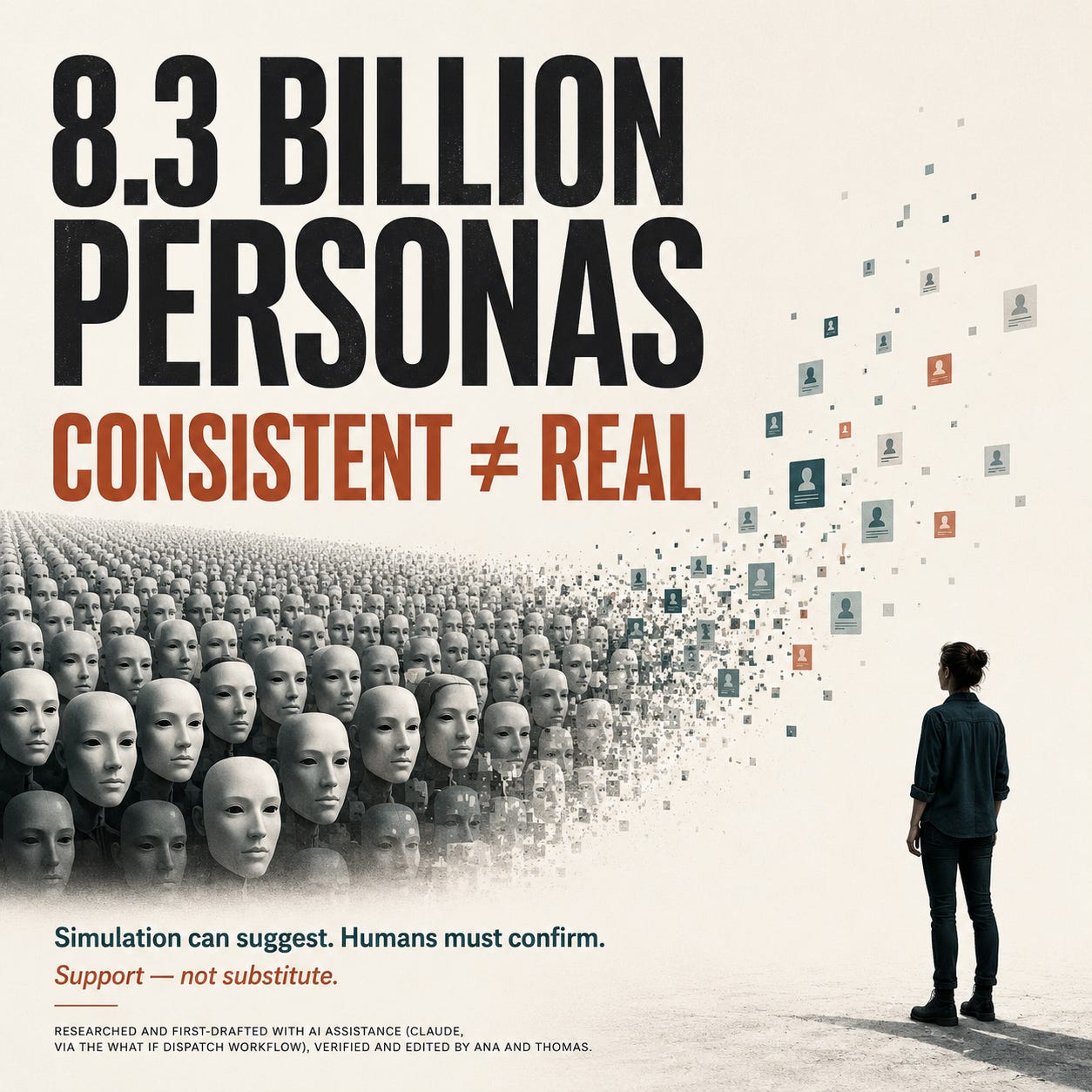
With this new MatrAIx study we have 8.3 billion personas that can be read as the whole of humanity finally in the room. It can be read as one narrow slice of humanity wearing 8.3 billion masks, at a resolution high enough to be mistaken for representativeness.
A 91.5% behavioural-adherence figure tells you the personas are *consistent*. It does not tell you they are anybody, because consistency is a property of the simulation; while validity is a property of the world.
Communicators might think this is the answer to their effectiveness prayers. But the benefit here is not NOT talking to humans but rather potentially simulating and reflecting on what those personas might do. The emphasis is on reflecting. And that needs some acknowledgement that models come with their cultural preferences too. A clue is not a finite answer. It demands time to play and explore, more variables to consider.
It is the same with prediction, from the earliest forms of divination, the interpretation of omens, oracles and however else humans strive to know the future to reduce uncertainty. From the Delphi Oracle to today’s algorithmically hypercharged Gigantic Data superforecasting models - we can’t shed the hubris of thinking we can bend nature and humanity to our will in quasi linear input/output fashion. From Myers-Briggs to OCEAN psychographics and other squeeze-humans-into-boxes models, forever looking for shortcuts when only the long route will really suffice.
Alex Edmans’ ‘ladder of misinference’ is the discipline we keep returning to: a statement is not a fact, a fact is not data, data is not evidence, evidence is not proof. A persona’s answer is a statement. It becomes evidence only once a human has been asked whether it holds.
We are not against simulation (Ana created her own metamodern spin off for cultural resonance for her executive MBA courses to help students “see” how a message “sounds” culturally and to reflect on the cultural values they take for granted and the cultural triggers embedded in every communication). So, no, we would rather not be read as the people who are reflexively against the latest data-led thing. We are data people after all.
Used as a hypothesis generator — a way of finding the questions worth asking real people — synthetic personas may well earn their place. However, used as a shortcut or substitute for the humans who are expensive to reach, they will quietly delete precisely those humans from the record, and the deletion will look like data. *Support and supplement — but not substitute*, as we keep saying, at the risk of becoming tiresome about it.
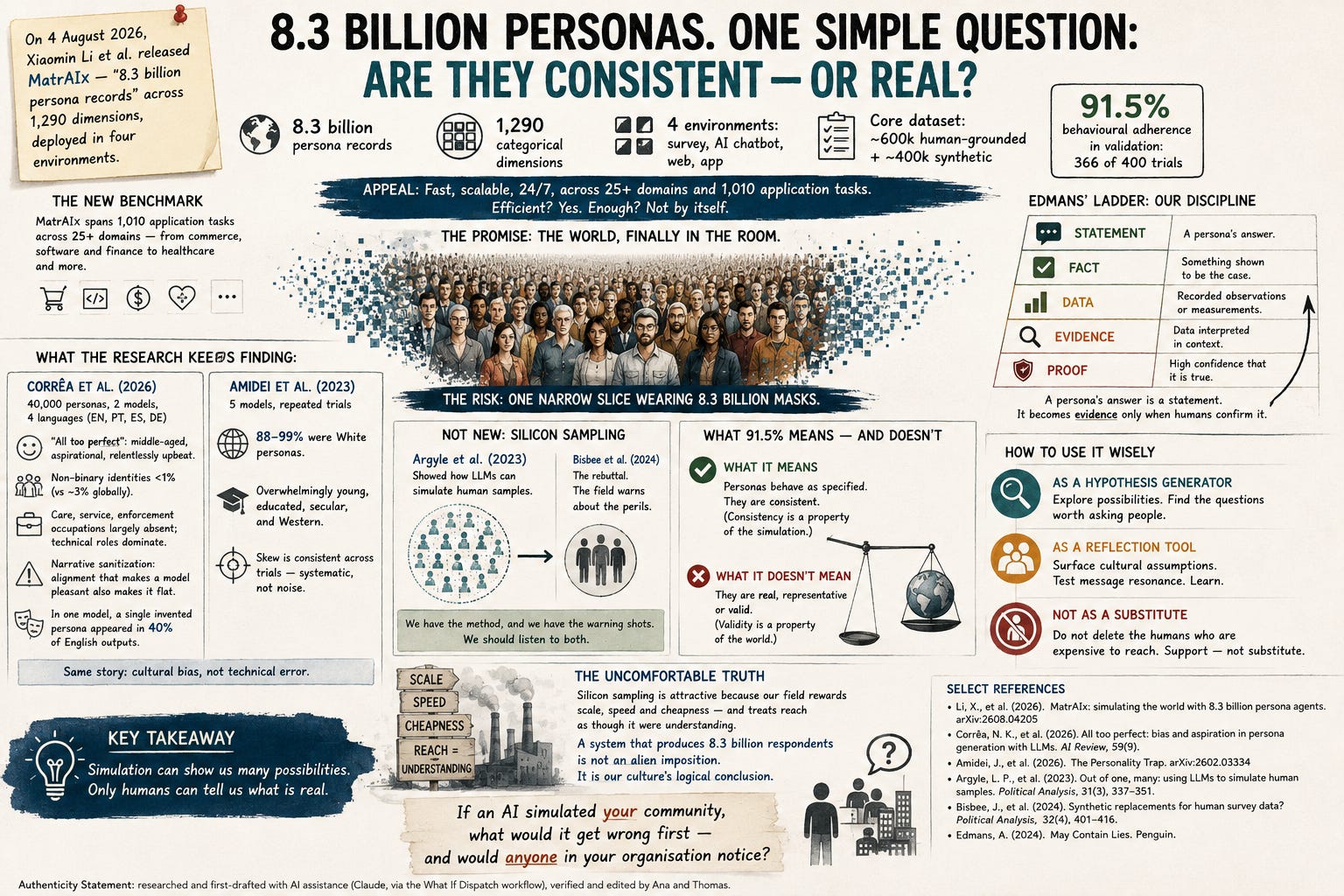
The uncomfortable part, which we cannot resolve in a dispatch: our own field’s measurement habits are what make silicon sampling attractive in the first place. We have spent decades rewarding scale, speed and cheapness in evidence, and treating reach as though it were understanding and insight. A system that produces 8.3 billion respondents is not an alien imposition on that culture. It is its logical conclusion.
Ask yourself this: if an AI simulated your community, what would it get wrong first — and would anyone in your organization notice?
References
Argyle, L. P., Busby, E. C., Fulda, N., Gubler, J. R., Rytting, C., & Wingate, D. (2023). Out of one, many: using language models to simulate human samples. Political Analysis, 31(3), 337–351. https://www.cambridge.org/core/journals/political-analysis/article/abs/out-of-one-many-using-language-models-to-simulate-human-samples/035D7C8A55B237942FB6DBAD7CAA4E49
Amidei, J., Ferreira, G., Serrano, M. M., Nieto, R., & Kaltenbrunner, A. (2026). The Personality Trap: How LLMs Embed Bias When Generating Human-Like Personas. arXiv preprint arXiv:2602.03334. https://arxiv.org/abs/2602.03334
Bisbee, J., Clinton, J. D., Dorff, C., Kenkel, B., & Larson, J. M. (2024). Synthetic replacements for human survey data? The perils of large language models. Political Analysis, 32(4), 401-416.
Corrêa, N. K., Weber Mallmann, R., Kaczér, D., Mai, F., Ilievska, A., & Mönig, J. M. (2026). All too perfect: bias and aspiration in persona generation with LLMs. Artificial Intelligence Review, 59(9). https://link.springer.com/article/10.1007/s10462-026-11641-3
Edmans, A. (2024). May Contain Lies: How Stories, Statistics and Studies Exploit Our Biases — And What We Can Do About It. Penguin.
Li, X., et al. (2026). MatrAIx: simulating the world with 8.3 billion persona agents. arXiv:2608.04205, submitted 4 August 2026. https://arxiv.org/abs/2608.04205