
Authenticity statement: Drafted by Claude based on the What If manifesto and our own writings. Added into a “brain” with a writing skill. Reviewed, verified, edited and approved by Ana and Thomas.
The tenets are not steps.
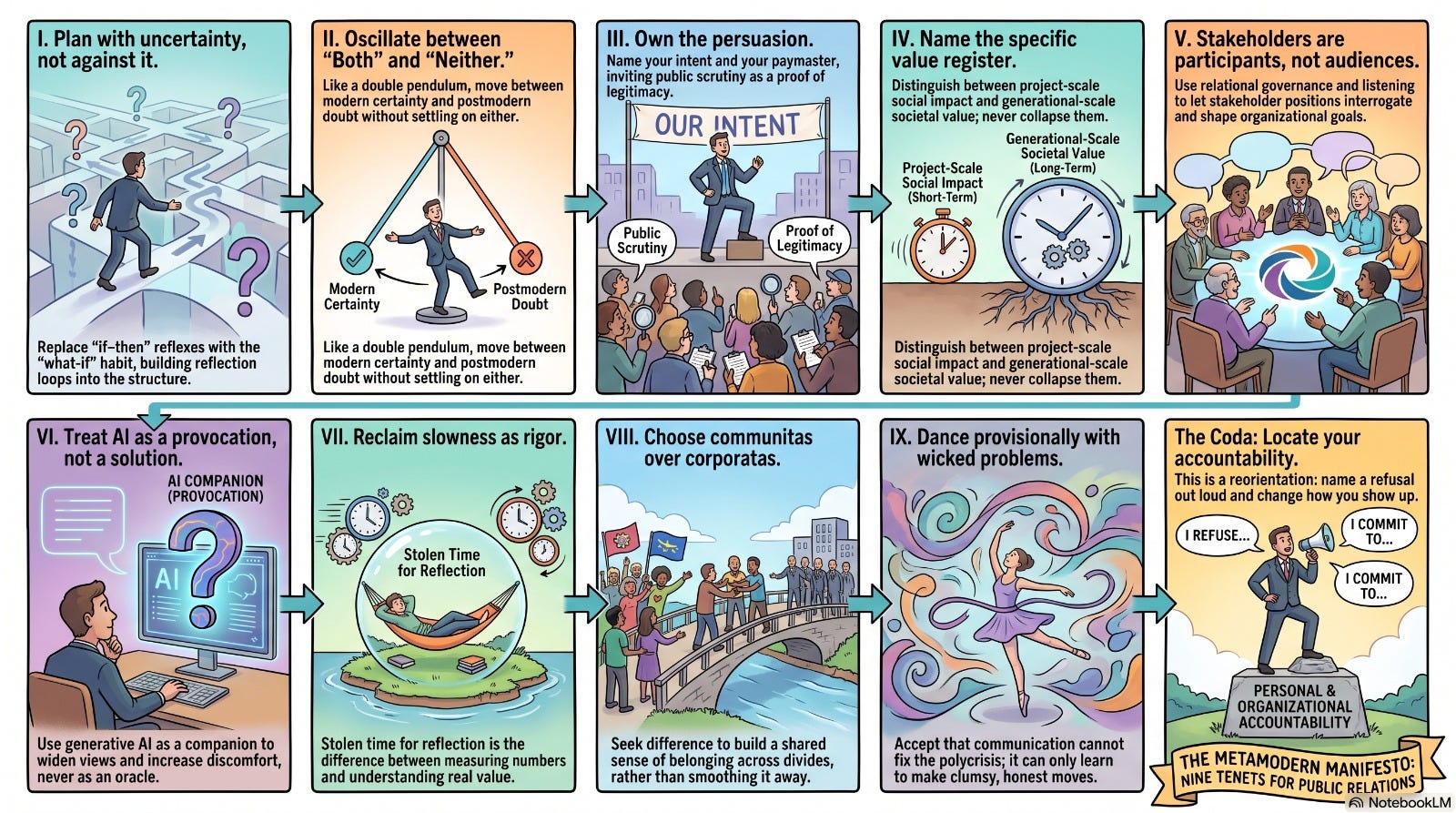
There is no order to work through, no maturity ladder to climb. They are nine commitments to hold, each pulling a little against the others. That is the point.
I. Plan with uncertainty, not against it. Replace the if–then reflex with the what-if habit. At every stage of a plan, ask: what if things change? What if we missed something? What if we misunderstood? Build the pause into the structure — revision loops, reflection checkpoints, room for tangents — because an insight is only as good as a knowledge base that can shift. This is the core of the What If framework, first set out in Stoeckle and Adi (2023) and developed into a full workflow in Adi and Stoeckle (2025). Not decoration. Structure.
II. Both. And neither. Modernist confidence proved too rigid for a wicked world; postmodern doubt too dissolving. Metamodernism does not split the difference — it oscillates, simultaneously modern and postmodern, and neither. Not a metronome’s steady tick, but a pendulum whose swing answers the moment (Vermeulen & van den Akker, 2010). Irma Meyer (2021) gave this its most PR-specific form — the good practitioner is “both a modernist and a postmodernist, or neither.” Nothhaft and Overton-de Klerk (2025) offer the governing image of a double pendulum: complexity on the problem side and the solution side at once. Whenever your position hardens into certainty, ask what it forecloses.
III. Own the persuasion. Name the intent, name the paymaster, and let the work be judged as what it is. The responsible persuader does openly what the field has long done apologetically — and accepts the scrutiny that openness invites as both the cost and the proof of legitimacy.
IV. Name the value register. Impact for whom, value to whom, decided by whom, on which clock. Social impact and social value are honest claims at project scale; public and societal value belong to connected work on deliberative and generational clocks. Each register is blind to what another sees. Connect them; never collapse them. If every answer points back at the organisation, start again.
V. Stakeholders are not audiences. Outside-in before inside-out. The organisational view is a perspective — self-interested, entitled to advocacy, required to accommodate. Planning worth the name lets stakeholder positions interrogate organisational goals, expects disagreement to survive the process, and treats a well-understood disagreement as a legitimate outcome. This is the field’s contingency-theory inheritance (Cancel and colleagues, 1997) turned toward what Adi and Stoeckle call relational governance — governing through relationship and listening rather than messaging — with roots in Dewey’s (1927) deliberative public. The lived version already exists in climate policy: France’s Citizens’ Convention (150 randomly selected citizens who produced binding-track recommendations on cutting emissions) and Ireland’s Citizens’ Assembly (which fed real biodiversity and climate policy) treated people as participants who set direction, not audiences to be messaged at. Research on these assemblies reports lower polarisation and a restored sense that ordinary people can shape decisions — tenets V and VIII (communitas over corporatas) working together.
VI. AI is a provocation, not a solution. Generative AI mirrors our sociotechnical condition: commercially driven, consequence-rich, wrapped in a there-is-no-alternative story. Use it as a companion that widens the view — more scenarios, more stakeholder positions, more discomfort. Never as an oracle, never as a substitute for relationship, always as a literacy still under construction (Stoeckle & Adi, 2025; Salzano & Ashby-King, 2025).
VII. Slowness is rigor. In a field addicted to speed, the radical act is time stolen back — for reflection, documentation, the second look. The pause is not lost productivity; it is the difference between measuring numbers and understanding value. We mistake speed for quality. Stop.
VIII. Communitas over corporatas. The deepest purpose of this work is cultivating shared meaning across difference. Instead of smoothing difference away, or campaigning forever to the like-minded until the echo chamber seals shut, metamodernism seeks difference. In a dividing and divided society the field’s normative remit is counterbalance: curators of complexity, facilitators of communitas — a shared sense of belonging built across, not against, difference. The lineage here runs through Sommerfeldt (2013) on PR and the civility of social capital, and Dewey (1927) on the public that democracy depends on.
IX. Dance with the problems. Communication cannot control, let alone fix, the problems of a wicked world. But it can learn to dance with them — clumsy solutions, provisional moves, honest about being provisional. It is the only ambition that survives contact with the polycrisis. The metaphor is deliberate: Nothhaft and Overton-de Klerk (2025) titled their metamodern intervention “Shall we dance?”
The coda
This is a reorientation, not a recruitment. Nothing to join. Everything to change. Take the tensions into your meetings and your breaks. Locate yourself on all four levels of accountability and notice which one you have been delegating. Then try something different: name a refusal, and make it out loud. The manifesto is unfinished on purpose — its name, like the field it addresses, is still moving.
References
Adi, A., & Stoeckle, T. (2025). A metamodern public relations workflow for the polycrisis. Public Relations Review, 51(4), Article 102619.
Cancel, A. E., Cameron, G. T., Sallot, L. M., & Mitrook, M. A. (1997). It depends: A contingency theory of accommodation in public relations. Journal of Public Relations Research, 9(1), 31–63.
Dewey, J. (1927). The public and its problems. Henry Holt.
Climate Policy. (2024–2025). A review of national citizens’ climate assemblies: Learning from deliberative events [and related articles on the Danish, French, and Irish assemblies]. Taylor & Francis. (Exact author details to be confirmed before publication.)
Meyer, I. (2021). The resurrection of modernistic public relations — A metamodern perspective. ESSACHESS, 14(1), 15–36.
Nothhaft, H., & Overton-de Klerk, N. (2025). Strategic communication and metamodernism. Shall we dance? Communicare, 44(1), 4–23.
Salzano, M., & Ashby-King, D. T. (2025). Examining proposed generative AI integrations in public relations: Offering participatory (AI) public relations. Public Relations Inquiry. Advance online publication.
Sommerfeldt, E. J. (2013). The civility of social capital: Public relations in the public sphere, civil society, and democracy. Public Relations Review, 39(4), 280–289.
Stoeckle, T., & Adi, A. (2023). Public relations, post-truth, and grand challenges. Organicom, 20(42), 86–102.
Stoeckle, T., & Adi, A. (2025). Strategic communication and generative AI: Creating or solving wicked problems? In Handbook of innovations in strategic communication (pp. 264–273). Edward Elgar.
Vermeulen, T., & van den Akker, R. (2010). Notes on metamodernism. Journal of Aesthetics & Culture, 2(1), Article 5677.
If this was useful, forward it to one person who’d get something from it.