
Authenticity statement: Drafted by Claude based on the What If Manifesto and our own writings, reviewed and edited by Ana and Thomas.
Responsibility that lives at only one level is an alibi. We used this exact example in our first post:
The practitioner blames the client, the client blames the market, the profession blames the jurisdiction, and society is told to be more resilient. Each level points at the next, and nobody is left holding anything.
This is reminiscent of what happened with Bell Pottinger. The agency went down. The people… we don’t know.
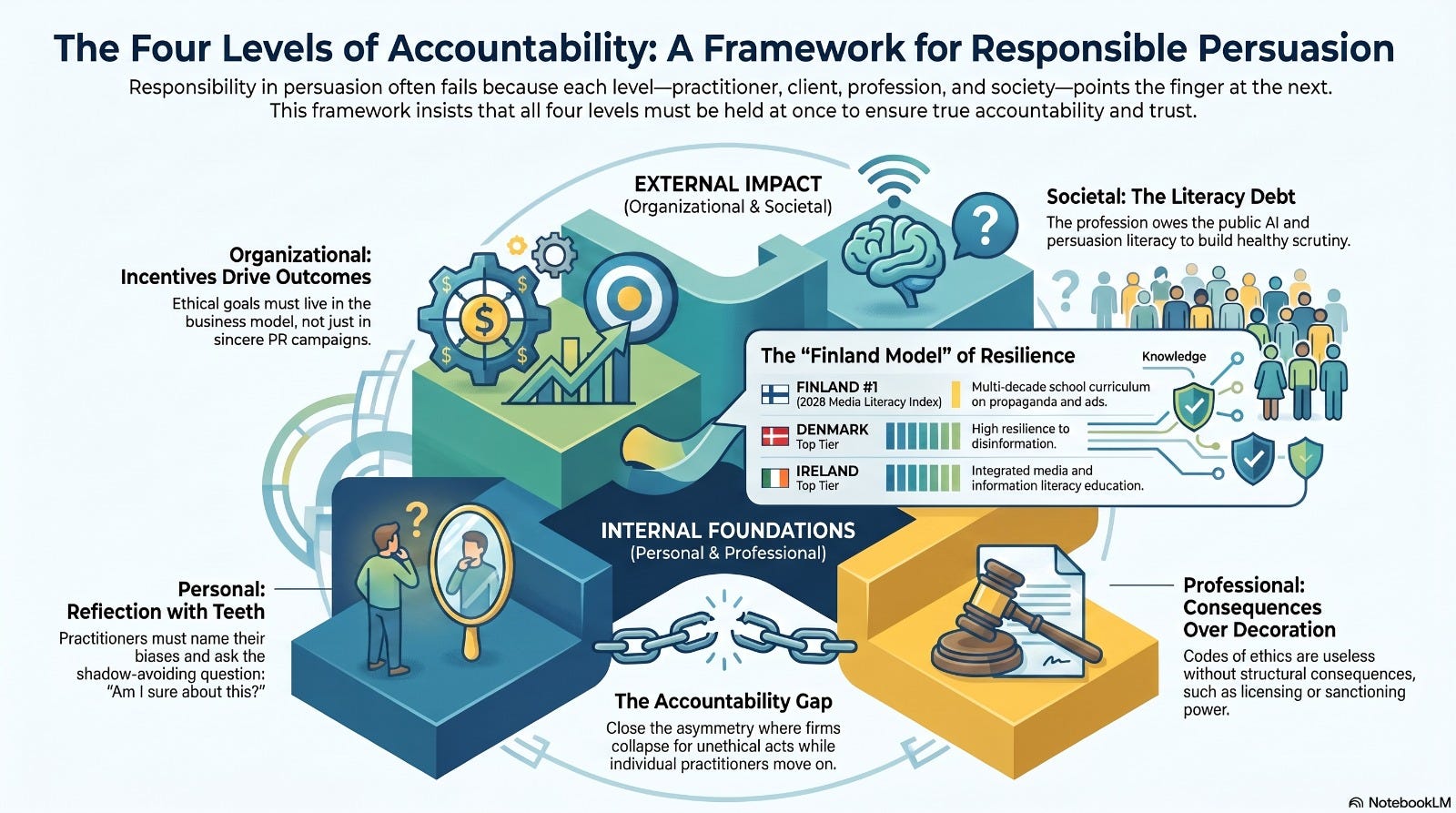
Our manifesto’s answer is that there four levels of accountability and negotiation, of calibration and adjustment in every situation: personal, professional, organisational, societal. Each comes with its own discipline, none delegable to the others.
It took a while to come up with this: personal, professional experiences and a wonderful research collaboration with Geah Pressgrove. With her we looked at purpose (and that piece is under review for now so we can’t say much) beyond the realization that between these four levels there are often misalignments and that the desire or tendency is to treat misalignment as bad, as something to be tamed and neutralized.
But we feel misalignment is where the productivity, the doubt and all the learning lives. Holding tensions means growth.
Personal: am I sure about this?
Responsibility starts with the practitioner, before any code reaches them. To thine own self be true (Shakespeare’s Hamlet) is harder than it sounds, because the self is not a reliable witness. We align with our in-groups, avoid discomfort, and reason our way to whatever our loyalties require. Joanna Fawkes (2015) drew on Jung to name this the profession’s “shadow.” So the personal discipline is reflection with teeth: know your values, name your biases and where they come from culturally, and keep asking the question every shadow avoids — am I, are we, sure about this? Principles like truthfulness, respect, and equity help as pocket equipment. They are not absolution.
Professional: codes without consequences are decoration
We mentioned Bell Pottinger earlier. When they stoked racial division in South Africa, the firm was punished and collapsed — and the individuals who did the work moved on to other jobs. That asymmetry is the professional accountability gap in a single case. A profession that openly owns persuasion has to be answerable at both levels: the organisation and the person.
The manifesto is deliberate about principle over mechanism here. Licensing, registries, arbitration boards with real sanctioning power are all possible routes — plausible in some countries, unthinkable in others. Accountability infrastructure is culturally and locally dependent, and exporting one model everywhere is its own kind of solutionism. What does not bend is the commitment: the profession must find its way to consequences, by whatever means its context allows, with professional bodies and educators building that route together rather than competing for members. The question is not whether to get there. It is how, even by different means. (This mirrors the argument in global AI-ethics governance, where UNESCO’s 2021 Recommendation insists that self-regulation is not enough — trustworthiness needs structural mechanisms.)
Organisational: incentives determine outcomes
Business models are incentive-and-reward structures, with consequences whether intended or not. If bettering society is a genuine business objective, it lives in the model — in what actually gets rewarded, funded, and promoted — or it is mere washing, however sincere the campaign. Communicators cannot outrun their organisation’s incentives. What they can do is make them visible and refuse to decorate them.
And the accountability for communication belongs to the whole organisation, not only its communicators. It is time to train organisations in communication, rather than only sending communicators to yet more training — time for leadership teams to reflect on their own understanding of communication and its persuasive weight. Everyone who represents an organisation communicates on its behalf. Everyone who communicates on an organisation’s behalf persuades on its behalf.
Societal: the literacies we owe
This is the outward duty, and the largest. A field that persuades for a living owes society the capacity to recognise and weigh persuasion. Persuasion literacy — how organised persuasive communication works, who pays for it, how to read intent — belongs in general education, not just trade curricula. And it now needs AI literacy beside it: knowing what generative systems actually do (fluent language without understanding), what and whose incentives drive them, and when the content they produce is persuading, and on whose behalf.
This is not hypothetical. Finland has taught media and information literacy across its schools for over a decade — starting in kindergarten, where children learn to question sources, and running through the curriculum with the study of real propaganda and advertising techniques. In the 2026 European Media Literacy Index, Finland again sits at the top of the ranking for resilience to disinformation. That is the societal literacy the manifesto is describing, built as public infrastructure rather than left to individual willpower. The metamodern extension is the obvious next move: add AI literacy alongside media and persuasion literacy, and treat both as things a persuasion profession owes the public — not as PR for PR, but as the scrutiny the field should want trained on itself.
Here is the twist the manifesto keeps returning to: we are sender and audience at once, so these literacies are owed to us as much as to the publics we address (that’s a wink to all “naturally” doing PR or falling into PR/PA as much as for anybody else). A field that builds public scrutiny builds the very scrutiny that holds it accountable. That is what it would mean for the role of PR in society to be an answer rather than an embarrassment — the profession of persuasion becoming the teacher of its own defences.
If this was useful, forward it to one person who’d get something from it.
References
Adi, A., Pressgrove, G., & Stoeckle, T. (2026, in press). Toward a metamodern approach to purpose in public relations and beyond: Conditions, contradictions, and critical reflections. Public Relations Review.
Adi, A. (2026). What is value, and to whom? [Public lecture]. University of Johannesburg & North-West University, South Africa.
European Policies Initiative / Open Society Institute – Sofia. (2026). Media Literacy Index 2026. (Denmark, Finland, Ireland, and the Netherlands lead the European ranking on resilience to disinformation.)
Fawkes, J. (2015). Public relations ethics and professionalism: The shadow of excellence. Routledge.
Fortune. (2025, January 29). Finland teaches 6-year-olds how to spot disinformation — and they might be better at it than you.
Shakespeare, W. (1603/2003). Hamlet (Act 1, Scene 3). Cambridge University Press.
UNESCO. (2021). Recommendation on the ethics of artificial intelligence. United Nations Educational, Scientific and Cultural Organization.
Agree - misalignment is not to be neutralized but accepted as an inevitable part of interpretation gaps and 'worked through'. It lives in meaning that has insufficient shared clarity to create coordinated action. Great piece!