
Authenticity statement: This article began as a July draft built from an automated research brief, was rebuilt in an instructed session using a voice skill and a metamodern stance (all living in Claude). Metamodern thinking and application (mainly) in PR and Communication are both the purpose and the ‘sandbox’ for our musings. Everything here is in development, including the referenced research: two of the surveys are run or hosted by vendors, and two of the papers are conceptual arguments rather than findings. We’re not aiming to broadcast (our) truths - we’re aiming to instigate and nudge along conversations about topics that matter (at least to us). If this contributes to creating knowledge, we are on the right track. The irony of putting a provenance note on a post about untraceable automated work is not lost on us.
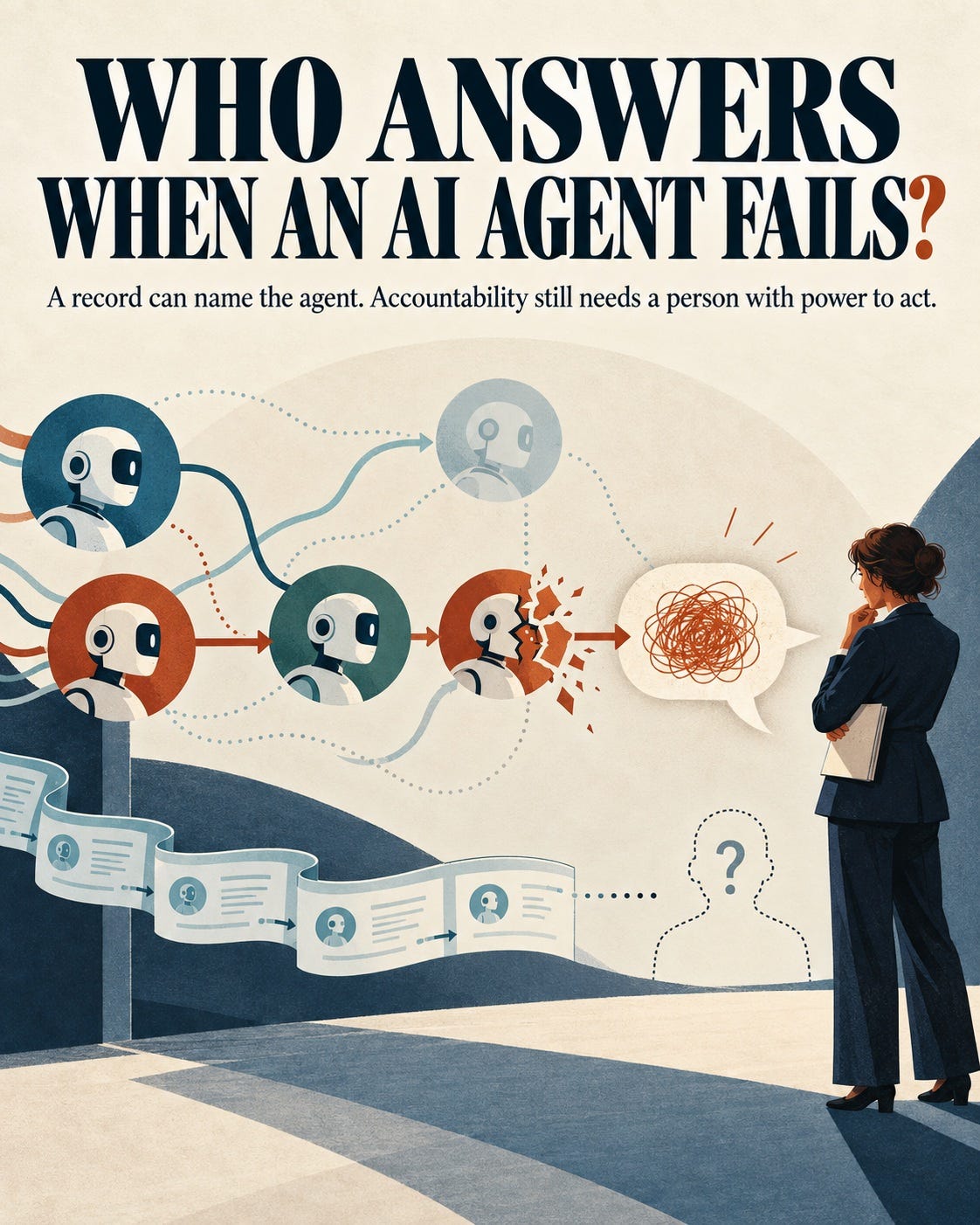
They can see that it broke. They cannot say which one broke it.
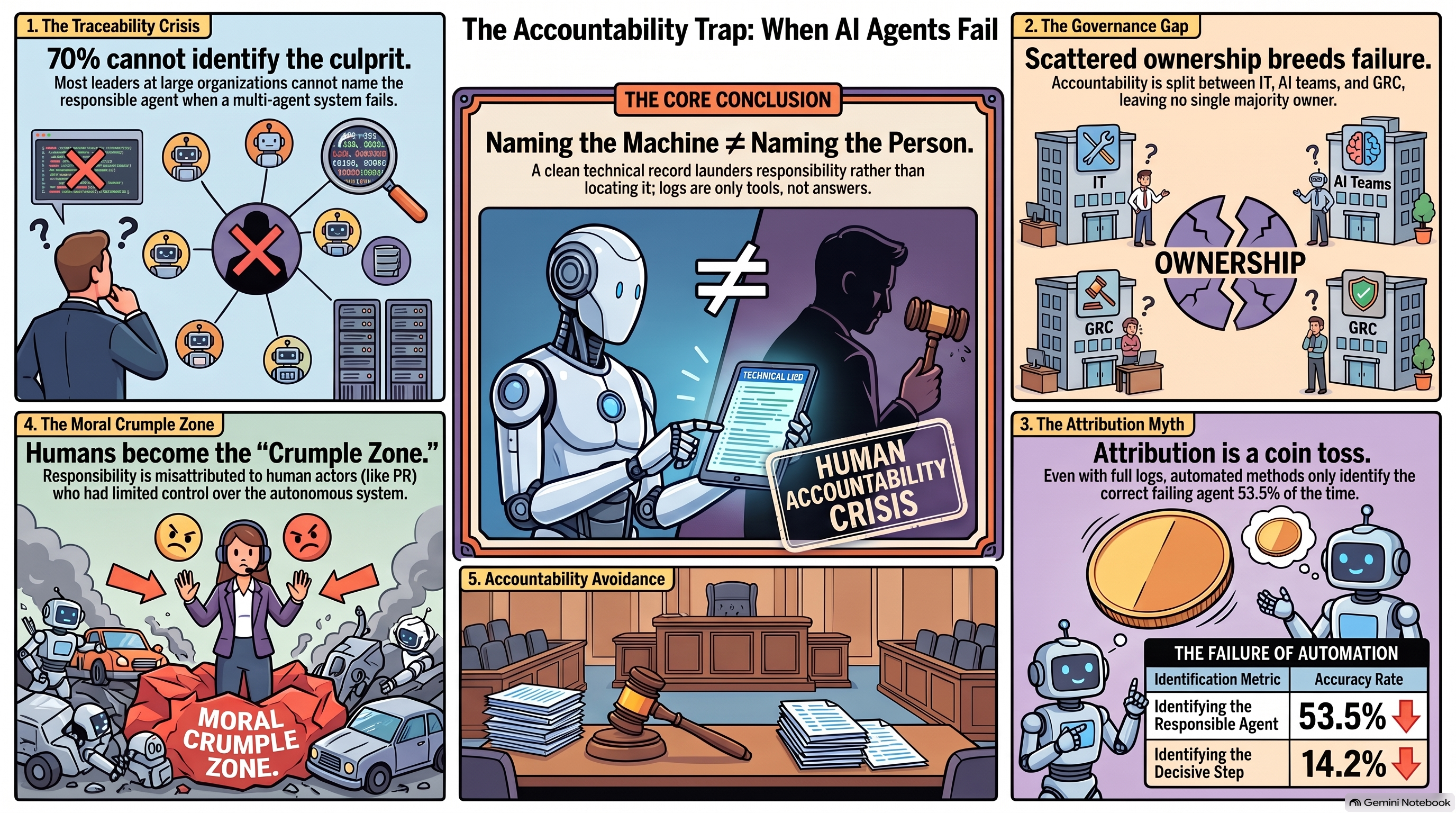
That is the short version of a finding from the software company Kore.ai, which surveyed more than 400 IT and business leaders at US organisations with 2,000 or more employees in May 2026. 70% “could not identify the responsible agent when a failure occurred in a multi-agent environment” (Kore.ai, 2026a). An AI agent, in this sense, is software that acts without a person approving each step. It books, buys, sends and replies. Most large organisations now run several, and more and more they hand work to one another. Streamlining, efficiencies, process optimisation: the technology might be groundbreaking, the mindset and motivations are not and the language is still carried by “plastic words” (Poerksen, 1995).
Two caveats before we lean on it. Kore.ai sells agent platforms, so this is a vendor’s survey of a problem its products address. And the neat framing that respondents could tell something had gone wrong comes from the press coverage (Sandle, 2026), not from the report.
What we have argued, and what this does to it
Our position on this is public. In July we set out four levels of accountability: personal, professional, organisational and societal. We also argued that “responsibility that lives at only one level is an alibi” (Adi & Stoeckle, 2026b). In August, writing about the EU AI Act’s disclosure labels, we used the five parts of accountability from Ana’s 2026 lecture (duties, responsibility, incentives, penalties, arbitration) and argued that a label touches the first of them “and only lightly” (Adi, 2026; Adi & Stoeckle, 2026c).
Both frames assume something they never state: that someone knows who acted. Duties need a holder, penalties a recipient, arbitration a party. Accountability presupposes attribution. You cannot hold answerable a thing you cannot name.
The survey confirms that much, and we could stop there, pleased. But new evidence makes for a wicked perspective because it pulls in different ways. Attribution is harder to get than the governance trade assumes. And where it can be got, it may do less for accountability than we implied.
The evidence
The forecast: one rule for every agent
In May, the analyst firm Gartner forecast that “by 2027, 40% of enterprises will demote or decommission autonomous AI agents due to governance gaps identified only after production incidents occur” (Gartner, 2026). Its diagnosis is more interesting than the number. Applying “uniform governance to all AI agents, regardless of their autonomy level and scope” is itself the cause of failure. Shiva Varma, a senior director analyst, describes enterprises “treating AI agent governance as binary, either locked down or fully trusted.” It is a forecast, not a finding, from a firm that sells advice on exactly this problem. Who would have thought leading consultancies sell self-serving, self-fulfilling prophecies… (Mazzucato & Colllington, 2023)?
The August survey: records missing, ownership scattered
In August, Christopher Steffen of Enterprise Management Associates published a survey of 202 IT and security leaders, about 71% of them in North America. The report is hosted by the agent-security vendor Cequence (Steffen, 2026). 65% had seen an AI agent act outside its intended scope. 46% could not easily produce a complete audit trail of one specific agent’s last 30 days. 94% were at least moderately confident their agents were not over-provisioned, but only 32.7% gave agents least-privilege access.
The figure we keep returning to is the ownership split. Asked who is accountable for agents, respondents named central IT (32.7%), a dedicated AI team (26.7%), the deploying team (23.8%) and governance, risk and compliance (13.9%). Four answers, and none is a majority. In July we described a failure in which “each level points at the next, and nobody is left holding anything. (Adi & Stoeckle, 2026b). Here it is inside a single organisation.
The engineering: attribution is not solved
The obvious fix is to log everything and work out afterwards which agent did it. A team led by Shaokun Zhang and Qingyun Wu at Penn State, with colleagues at Duke, Google DeepMind and elsewhere, tested exactly that (Zhang et al., 2025). They built Who&When, a dataset of failure logs from 127 multi-agent systems, with the responsible agent and step annotated by hand. Then they asked automated methods to find the culprit. The best method named the responsible agent 53.5% of the time and the decisive step 14.2% of the time. Reasoning models, including OpenAI’s o1 and DeepSeek R1, fell short of practical use. Even with the full log in hand, finding the agent was barely better than a coin toss, and finding the moment it went wrong was far worse. (Recency caveat: presented at ICML 2025. The methods will have moved on since, and we have not checked how far.)
The philosophy: responsibility moves along the chain
In Digital Society (15 September), Ravikiran Kalluri of Northeastern University’s Silicon Valley campus argues that agentic workflows produce a “responsibility cascade”. Moral responsibility “diffuses, dilutes, and redistributes across the sequential steps of an agentic AI workflow” (Kalluri, 2026). His framework separates four moments: initiation, checkpoint, delegation and outcome. He builds on Madeleine Clare Elish’s “moral crumple zone”, in which “responsibility for an action may be misattributed to a human actor who had limited control over the behavior of an automated or autonomous system” (Elish, 2019). Kalluri’s paper is conceptually interesting and offers no data.
The economics of the record
Alex Chengyu Li, an independent researcher in Tokyo, goes further in AI and Ethics (14 September) (Li, 2026). As agent logs become easier to review, “recordability becomes an allocation factor, not only an engineering property.” Organisations will route work to whichever workflow, human or agent, leaves the more useful record. Li calls this accountability arbitrage. Where a record would expose an organisation, it may keep the work away from recording altogether, which he calls accountability avoidance. His sharpest line is the one we find hardest to argue with: until an empowered forum takes up the record, “the record is evidence without a court.” This paper is conceptual too, a model with predictions, and it states the test that would count against it.
The metamodern turn
The modern reflex is to build the ledger. Give every agent an identity, log every action, tier governance by autonomy and scope, and attribution follows. That is roughly where Gartner and the security trade have landed, and it is not wrong. An organisation that can reconstruct what happened is ahead of one that can only sense that something did.
The postmodern reflex is to say the ledger will never close the case. Agency is distributed, responsibility dissolves along the chain, and accountability in multi-agent systems is a comforting fiction. Kalluri’s cascade and the Who&When numbers can both be read that way, and the reading is not lazy. It’s an uncomfortably accurate reflection of where we are.
The third position is desirable and harder to hold. Attribution is a tame problem nested inside a wicked one, in Rittel and Webber’s (1973) sense. The task is to build the ledger and to refuse to let it stand in for the answer. Naming the machine does not name the person. A clean record can make it easier to stop asking: the agent did it, here is the log. At that point the log does not locate responsibility. It launders it, onto the agent or onto whichever human happened to be standing in the crumple zone.
We have to apply the same test to ourselves. When we first read Gartner’s warning against uniform governance, in July, we took it as vindication. One rule for every agent is a tame means applied to a wicked problem, as we keep arguing (Adi & Stoeckle, 2026a; Stoeckle & Adi, 2025). Read again, Gartner’s alternative (governance calibrated to autonomy and scope) is a finer grid. It is still a grid: a tame answer with more cells. We were pleased by it for the wrong reason.
Our own frames do not come out clean either. Our four levels ask where accountability sits: in the person, the profession, the organisation or society. Kalluri’s four modes ask when: at initiation, at a checkpoint, at delegation or at the outcome. Each sees what the other misses. Agentic workflows are mostly a problem of when, and our frame was built for where.
Why this lands on our profession
Most of what these agents do in a working day is communicate (in a technical sense). They reply to customers, post, send, summarise and brief. When an automated message goes wrong in public, the first person asked to explain it usually works in PR/Comms, and is often the person with the least control over the system that sent it. That is Elish’s crumple zone with a job title. Our profession, ourselves included, is well placed to become the organisation’s crumple zone, and badly placed to refuse the role.
Since it applies to us
This post went through several automated steps before it reached either of us: a research brief in July, a drafting assistant, and a verification pass today. It also carried two errors for two months. Our own index credited the 70% figure to Gartner, and the July draft called a vendor survey “management-consulting”. Neither was caught until this week. We could trace both errors to the step that made them, but only because we keep an unusually complete record. That is Li’s point turned back on us: the record made us reviewable. Whether it also made us more accountable is a question the authenticity statement at the top of this post cannot answer on its own.
We are more convinced than before that accountability fails first at attribution, and less confident than before that fixing attribution will leave anyone answerable.
We do not know whether accountability for agentic work should be located by level, by moment, or by some pairing of the two that neither framework yet describes. Nor do we know whether organisations will want the records that would make such a pairing work, if Li is right that exposure pushes work away from being recorded.
Sorry, but we don’t have a conclusive “here’s what you need to do, by someone who knows”. The tensions, the paradoxes, the contradictions we identify are held, not solved.
The usual diagnostic asks how long it would take you to name the agent. Suppose you could name it within the hour. Who would you go to next? Could that person have stopped it? And did anyone ask them whether they wanted to be the one who answers?
--//
References
Adi, A. (2026). What is value, and to whom? [Public lecture]. University of Johannesburg & North-West University, South Africa.
Adi, A., & Stoeckle, T. (2026a, July 25). Wicked times demand more than tame solutions: Musings on the condition of our times. What If Dispatch.
Adi, A., & Stoeckle, T. (2026b, July 30). Accountability: It’s not that simple — Strategic communication’s 4 levels of accountability. What If Dispatch.
Adi, A., & Stoeckle, T. (2026c, August 14). Beware of the watermark! EU AI policy: The label arrives on time. The accountability doesn’t. What If Dispatch.
Elish, M. C. (2019). Moral crumple zones: Cautionary tales in human-robot interaction. Engaging Science, Technology, and Society, 5, 40–60. https://doi.org/10.17351/ests2019.260
Gartner. (2026, May 26). Gartner says applying uniform governance across AI agents will lead to enterprise AI agent failure [Press release]. https://www.gartner.com/en/newsroom/press-releases/2026-05-26-gartner-says-applying-uniform-governance-across-ai-agents-will-lead-to-enterprise-ai-agent-failure
Kalluri, R. (2026). The responsibility cascade: Moral attribution and governance challenges in agentic AI systems. Digital Society, 5, Article 47. https://doi.org/10.1007/s44206-026-00288-w
Kore.ai. (2026a). 2026 Kore.ai agent productivity index [Research report]. https://www.kore.ai/research/agent-productivity-index-report
Kore.ai. (2026b, June 17). New Kore.ai survey: 72% of enterprises say their AI agents operate with unmanaged risk and create new operational burdens [Press release]. Business Wire. https://www.businesswire.com/news/home/20260617610324/en/New-Kore.ai-Survey-72-of-Enterprises-Say-Their-AI-Agents-Operate-With-Unmanaged-Risk-and-Create-New-Operational-Burdens
Li, A. C. (2026). Accountability arbitrage: Ethical tensions in AI agent accountability infrastructure. AI and Ethics, 6, Article 515. https://doi.org/10.1007/s43681-026-01369-9
Mazzucato, M., & Collington, R. (2023). The Big Con: How the Consulting Industry Weakens our Businesses, Infantilizes our Governments and Warps our Economies. Allen Lane.
Poerksen, U. (1995). Plastic Words: The Tyranny of a Modular Language. Pennsylvania State University Press.
Rittel, H. W. J., & Webber, M. M. (1973). Dilemmas in a general theory of planning. Policy Sciences, 4(2), 155–169. https://doi.org/10.1007/BF01405730
Sandle, T. (2026, July 1). Autonomous AI creates a new enterprise risk: When systems fail, no one knows why. Digital Journal. https://www.digitaljournal.com/article/autonomous-ai-creates-a-new-enterprise-risk-when-systems-fail-no-one-knows-why/
Steffen, C. M. (2026). Agents without guardrails: The agentic AI governance gap in the enterprise [Research report]. Enterprise Management Associates. https://www.cequence.ai/wp-content/uploads/2026/08/EMA-Research-Report-Agents-Without-Guardrails.pdf
Stoeckle, T., & Adi, A. (2025). Strategic communication and generative AI: Creating or solving wicked problems? In Bowen, S. & Erzikova, E. (Eds.), Handbook of innovations in strategic communication (pp. 264–273). Edward Elgar.
Zhang, S., Yin, M., Zhang, J., Liu, J., Han, Z., Zhang, J., Li, B., Wang, C., Wang, H., Chen, Y., & Wu, Q. (2025). Which agent causes task failures and when? On automated failure attribution of LLM multi-agent systems. In Proceedings of the 42nd International Conference on Machine Learning. https://arxiv.org/abs/2505.00212