
Authenticity statement: researched and first-drafted with AI assistance (Claude, via the What If Dispatch workflow), edited and approved by Ana and Thomas.
From September, IESE is rebuilding its full-time MBA. AI goes into every first-year course, and the whole programme reorganises around one problem the school now calls central: how to lead an organisation where people and AI systems work side by side. The stated scarce skill is not producing the analysis — AI does that now — but “judgement under pressure”: handling ambiguity, aligning stakeholders, acting while uncertain. This sounds reassuringly familiar to metamodern ears.
IESE isn’t alone. Across the elite business schools tracked by the Poets&Quants platform, 2026 reads like a shared turn toward “leading in paradox” as the main thing being taught. And it’s worth pondering why that phrase is showing up in business-school brochures, of all places, because the reason is more interesting than the trend.
They didn’t arrive here through theory. No dean read a paper on metamodernism and redesigned a curriculum. They arrived there because AI ate the other thing. For decades the MBA sold analysis: build the model (BCG Matrix, anyone?), run the numbers, produce the recommendation. That was the product, and it was teachable, gradable, scalable. It also infantilised clients (including governments and states) and distorted economic decision-making, according to The Big Con, the very readable and well-informed polemic by Mariana Mazzucato and Rosie Collington.
AI now does the analysis faster and cheaper than a second-year student. So the schools are left asking what remains that’s worth two years and a large tuition fee – and the honest answer coming back is: the judgement the analysis was never actually able to give you.
This is the pattern Howard Nothhaft and Nina Overton-De Klerk describe for strategic communication — a field turning out to have been an “unknowingly metamodern project” all along, doing the paradox-holding work without the vocabulary for it. Business schools are now a live instance. Pushed by algorithms, not by a manifesto, they’ve conceded that the checklist-able part of management was the replaceable part, and that what’s left is exactly the un-checklist-able capacity to hold a decision open when the situation won’t resolve.
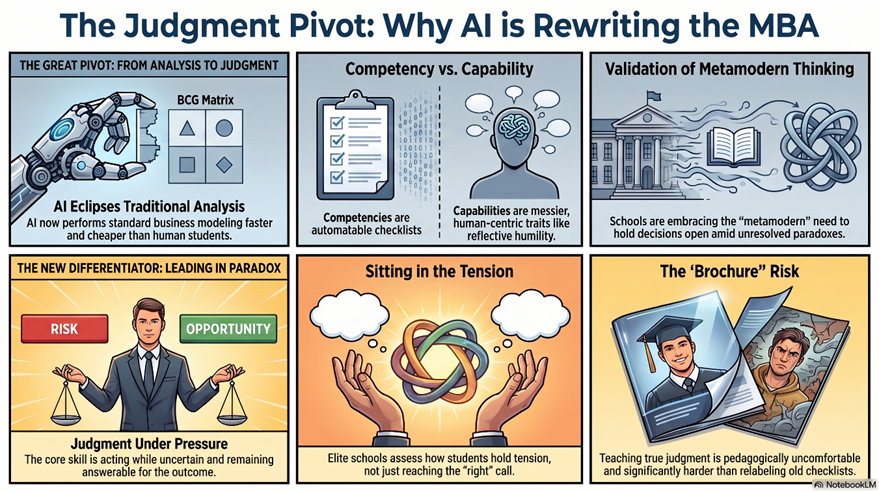
That distinction – capability over competency – is one that we keep returning to (from the perspective of PR scholarship, see Gregory & Fawkes, 2019). A competency is a discrete, listable skill: run a regression, build a comms plan, read a balance sheet. You can certify it, and increasingly you can automate it. A capability is different and messier: reflective humility, adaptability, the nerve to act under real uncertainty and stay answerable for it. It doesn’t fit on a checklist, which is why it was always undervalued – and why it’s suddenly the only thing left standing once AI takes the checklist. IESE’s redesign is that revaluation, in real time, with a tuition price attached.
We’d add one note of caution, in fairness, because there’s a way this goes wrong. “Judgement,” “leading in paradox,” “comfort with ambiguity” — these are also very easy to say and very hard to teach and assess. There’s a real risk that “we teach judgement now” becomes the new brochure line, as hollow as “we teach leadership” got – a competency checklist re-labelled with fashionable words, because a paradox you can grade is not a paradox. The interesting schools will be the ones that let students sit in genuinely unresolved cases and be assessed on how they hold the tension, not on whether they reached the “right” call. That’s pedagogically uncomfortable and administratively inconvenient. It’s also the whole point. Whether IESE builds the demanding version or the brochure version is the thing to watch.
For our own work, teaching communication, leadership, AI in executive education, building the PMAT and What If tools, this is both encouragement and warning. Encouragement, because the market is now arriving on its own at “teach the paradox, not the answer.” Warning, because arriving at the words is not the same as building the thing, and the gap between them is where most curricula will quietly settle.
So the question we’d leave with anyone who teaches, trains, or hires: when AI can produce the analysis, what are you actually developing in a person, and can you tell the difference between teaching them to hold a hard call open, and teaching them a new checklist with the word “judgement” printed on top?
References
Gregory, A., & Fawkes, J. (2019). A global capability framework: Reframing public relations for a changing world. Public Relations Review, 45(3), 1-13. https://doi.org/https://doi.org/10.1016/j.pubrev.2019.05.002
Mazzucato, M., & Collington, R. (2023). The Big Con: How the Consulting Industry Weakens our Businesses, Infantilizes our Governments and Warps our Economies. Allen Lane. https://books.google.co.uk/books?id=dj9uEAAAQBAJ
Nothhaft, H., & Overton-De Klerk, N. (2025). Strategic Communication and Metamodernism. Shall We Dance? Towards Complexity Beyond Linear Compromise. Communicare: Journal for Communication Studies in Africa, 44(1), 4-23. https://doi.org/10.36615/ka65me09