
On 2 August, the European Commission switched on its enforcement powers over general-purpose AI models. It can demand documents, evaluate models, order recalls, and levy fines. On the same day, Article 50 of the EU AI Act went into full effect: chatbots must tell you that you are talking to a machine, AI-generated content must be marked - in fact, watermarked (as per the recent Anthropic announcement that has the AI commentariat in a frenzy), and deepfakes must be labelled.
This is good, we think. It is also less than it looks. Disclosure is one move: “you are dealing with a machine”. Accountability is a different move: “someone answers for what the machine does.” The Act makes the first one mandatory. It does not address the second.
In a lecture earlier this year Ana laid out accountability as five parts, not one: duties (who is supposed to do what), responsibility (who owns the outcome), incentives (what rewards good behaviour), penalties (what follows bad behaviour), and arbitration (who decides when people disagree). A disclosure label touches the first of those and only lightly. It tells you the source. It does not tell you who is answerable when the AI-written statement misleads you, who is penalised, or where you go to contest it.
The label is not the process. It is one part, dressed as the whole.
We want to be fair to the Act, because the reflex in our field will be to over-read it. Trade commentary is already treating 2 August as the day AI communication “got regulated,” full stop. It didn’t. It got disclosed. Those are not the same, and the difference is exactly the one that organized persuasive communication — the honest name for a lot of what we call PR — has spent years learning the hard way. Telling people a message is sponsored is not the same as being answerable for whether it’s true, and what the implications are. We already know this. We wrote some of those disclosure rules ourselves, and now we recite them about AI with special conviction.
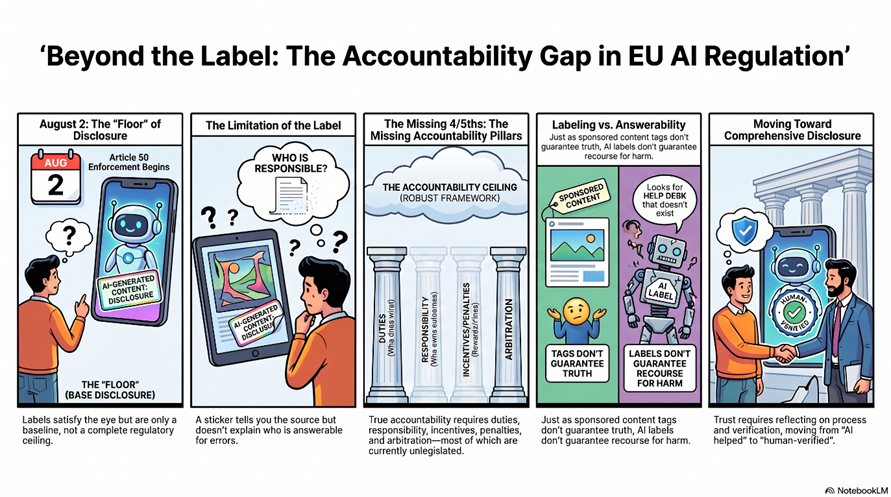
Here is the part that gives us pause. A disclosure regime can make everyone feel more protected while changing very little about who carries the risk. The label satisfies the eye. The accountability structure — the boring four-fifths — is where the protection actually lives, and none of it is legislated here. A well-labelled system that no one is answerable for is still a system no one is answerable for. The sticker just makes it look handled. I mean, there’s a watermark now, right…?
There’s a version of this post that would end by telling you what the Act should have done instead. We’re not going to, partly because “hold accountability open across five elements, not one” is not a clause you can drop into a regulation and partly because we don’t think the answer is more rules stacked on the label. Plus, we don’t claim to be experts. However, we feel this is a valid observation: the answer, if there is one, is that disclosure is a floor and we keep mistaking it for a ceiling.
And while we’re here: this Dispatch discloses how it’s made — AI research assistance, human review and editing. That’s the same move the Act mandates, and it carries the same limit. Saying “AI helped write this” is insufficient. To build trust, it needs to be a show and tell on how AI was used (in a forthcoming book on sustainable AI, we use different levels of AI use disclosure, from “no AI” to “human first” to “AI first, AI generated – human edited”). A comprehensive act of disclosure is more than a boilerplate statement: it requires reflection and acknowledgement of process, sources and verification. But you’ll have to trust us that we did what we say.