
A recent article by Raina Lazarova, VP of Global Insights at Muck Rack and Chair of AMEC, Beyond Vanity Metrics, presents a mature, progressive stance on public relations and communication measurement, a welcome and necessary push for the industry. The piece rejects Advertising Value Equivalents (AVEs) (again!) and urges professionals to set clear objectives aligned with the Barcelona Principles, thus advocating for connecting communication activity to concrete organizational outcomes. This works for many scenarios that communicators find themselves in, when problems are defined from the perspective of the organization and success is also defined in alignment with organizational objectives (and desired contributions or outcomes). In our What If Manifesto, we describe such scenarios as tame: predictable, addressable through standard operating procedures with clear objectives, measurable steps and a set of key performance indicators that deliver hard currency data.
The challenge communication planners are increasingly facing though is that there is another set of scenarios, at the heart of which are wicked problems. This is not to say that tame problems and tame solutions aren’t any valid anymore, but rather that our world increasingly resists straightforward approaches. In a recent What If Dispatch, we describe these problems as complex, interconnected, and open-ended; they resist definition and have no single correct solution.”
The core friction between these two perspectives lies in their fundamentally different understandings of the environment in which communication occurs.
The tame approach assumes a predictable, linear world where practitioners can draw a straight line from a communications output to a predetermined organizational outcome. The Manifesto, conversely, argues that we now operate in a “polycrisis” defined by radical uncertainty, where applying standard operating procedures, SMART objectives, and KPIs creates a dangerous “false sense of security”: tame solutions don’t work for wicked problems.
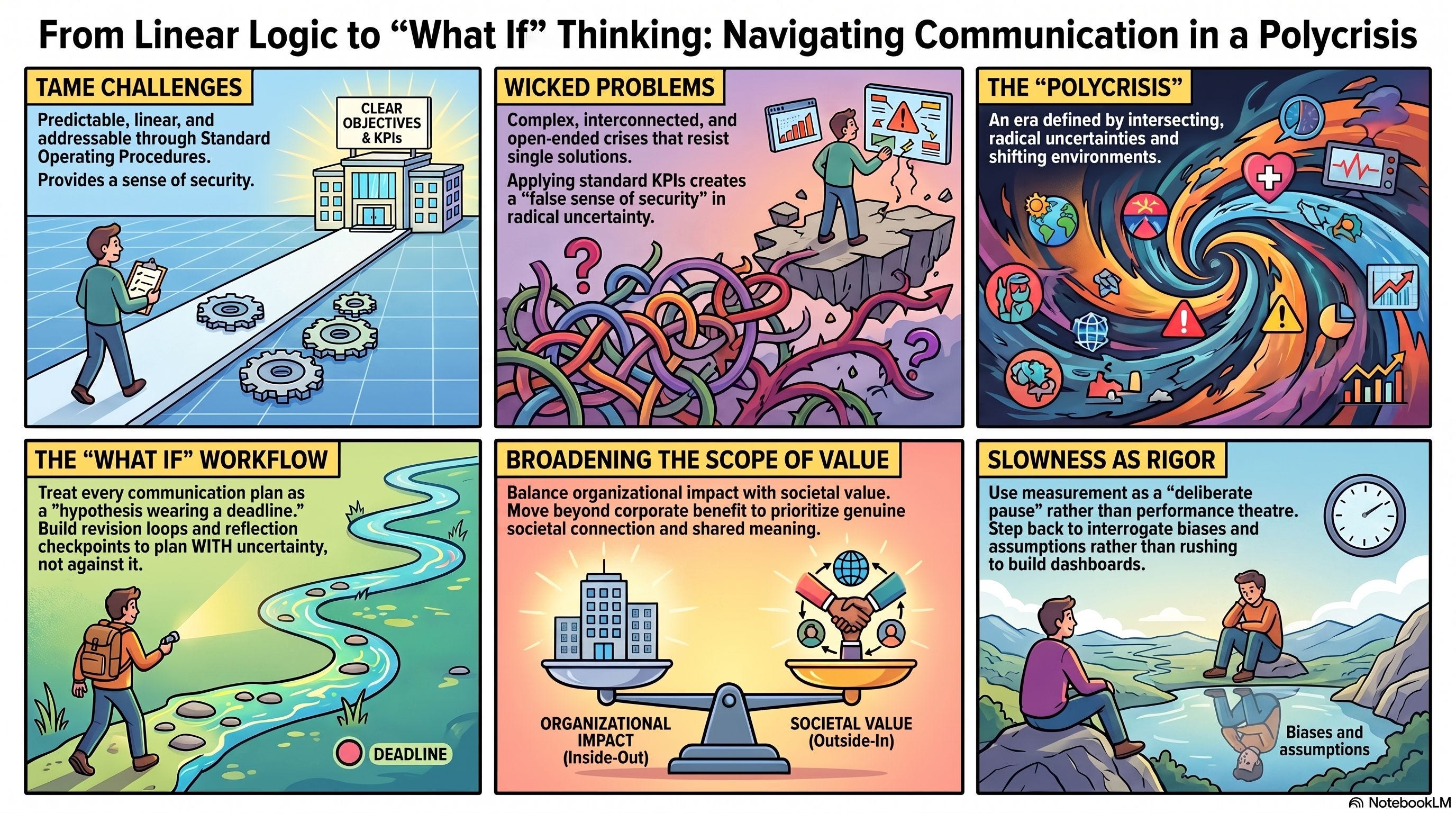
To build upon Lazarova’s foundation and truly mature the profession for complex times, the What If Manifesto offers several actionable suggestions to elevate our practice:
1. Shift from “If-Then” Planning to a “What-If” Workflow
The emphasis on setting clear objectives before launching a campaign is undisputed. The metamodern practitioner takes this further by actively planning with uncertainty rather than against it. Instead of treating a communication plan as a rigid roadmap, treat it as a “hypothesis wearing a deadline”. Practice building “revision loops” and “reflection checkpoints” into your measurement cycles, constantly asking “what if things change?” as new, unpredictable data emerges. We first wrote about this some time ago in an Organicom piece where we show how easy this If-then can turn into what-if .
2. Broaden the Scope of “Value”
We agree that “the value of a metric depends entirely on the purpose it serves” and that connecting activity to organizational outcomes is mandatory (for starters it gives clarity, context and direction). However, while measuring organizational impact is a legitimate starting point, the Manifesto challenges us to stop treating the organization as the sole “protagonist”. Practitioners should actively separate their metrics into distinct registers: short-term organizational impact (inside-out) versus long-term public or societal value (outside-in). Both perspectives matter and need to be held in tension in a responsible metamodern strategic communication perspective. If all your measurement answers point back to the organization’s benefit, the strategy needs to be re-evaluated.
3. Embrace Slowness as Rigor
Advanced measurement is often framed as a way to survive budget discussions and prove departmental worth to leadership—securing a “seat at the table”. The Manifesto cautions that this can devolve into mere performance theatre if we aren’t careful (just think of increasing the number of followers and having you focused on engagement without seeing any behavioral change or mental association and connection as a result; growth for growth’s sake or being busy and loud for the promise of visibility). Instead of rushing to build bigger better dashboards to prove efficiency based on ‘near-real time data’, use measurement as a deliberate pause. In a fast-paced industry, “slowness is rigor”. Use the data to step back, reflect on biases, ask ‘what are we missing’, ‘what if our assumptions are flawed’, ‘what other explanations are there for this data’ (see Alex Edmans’ work on data and assumptions) and interrogate whether the campaign is actually fostering shared meaning (”communitas”) or just talking at an audience.
Yes, it is absolutely right to push the industry beyond surface-level vanity metrics (and still highly necessary). However, tame solutions can only ever replace a simplistic organizational scorecard with a more sophisticated one. To truly evolve in an era of intersecting crises, our field will benefit from a reflexive “What If” workflow. This means transitioning from applying organization-focused managerial control (remember Communication Controlling?) to acting as “curators of complexity” who prioritize genuine societal connection—communitas—over corporate metrics.
No, this is not what organizations consistently ask and pay for. But it is where society under conditions of polycrisis is moving. Sooner or later, organizations will get the point. Why wouldn’t communication, measurement and evaluation aim to take the lead on this?
Like the jumping-off point of Raina's article into your agenda.
Raina makes an important point. The comms industry has feebly spent years trying to move beyond AVEs - which it seems finally to have sloughed (despite recidivist client insistence on using it) - but replacing one set of simplistic metrics with another doesn’t really move the profession forward. A metric isn’t “good” or “bad”. It’s only ever fit, or unfit, for the question you’re trying to answer.
The line that resonated most with me is that reports should explain not just what happened, but why it happened and what to do next. That’s where measurement starts to become genuinely valuable.
I’d add one further thought. Measurement can tell us whether we’ve achieved our objective. But on its own, it can’t tell us whether we were chasing the right objective in the first place. That’s a question of judgement.
As AI makes measurement quicker, cheaper and more sophisticated, the competitive advantage won’t come from producing more dashboards. It will come from asking better questions, applying better judgement and making better decisions.
Evidence informs. Human insight decides.