
Authenticity statement: This article is not the result of a scheduled task or an automated brief. It is an instructed and guided draft using a voice skill and a metamodern project (all living in Claude), built from material we wrote and presented ourselves, and thorough edits by Ana Adi and Thomas Stoeckle. Metamodern thinking and application (mainly) in PR and Communication are both the purpose and the ‘sandbox’ for our musings. Everything here is in development, including the conference papers referenced below, which are working versions rather than published articles. We’re not aiming to broadcast (our) truths - we’re aiming to instigate and nudge along conversations about topics that matter (at least to us). If this contributes to creating knowledge, we are on the right track.
At the wonderfully well executed EUPRERA congress in Málaga (thx Isabel Ruiz-Mora, Alejandro Álvarez-Nobell and team), we explained metamodernism every time we used it. The explaining turned out to be the opportunity rather than the obstacle.
Metamodernism found us a good 8, 9 years ago and steadily over the years, it became more central to our thinking about the challenges we are faced with in academia and practice - but also to our thinking about thinking: how do we (try to) make sense of a world that increasingly appears to be resistant to sensemaking as we knew it…?
Applied specifically to public relations and strategic communication, we have started to argue that we need a planning logic built for problems that do not resolve: what-if rather than if-then, oscillation as a standing condition rather than a stage a practitioner graduates out of, reflexive checkpoints written into the workflow instead of bolted onto the evaluation (Adi & Stoeckle, 2025).
At the 27th EUPRERA Annual Congress, we had the chance and challenge to show to a mostly academic audience what metamodernism does in three places where it can actually be observed — research design, classrooms, and practice — and to say where the metamodern move earns its keep: it supplies, through oscillation and humble curiosity, an insight that neither the modern nor the postmodern position in our own discipline can reach.
Regenerating PR
The congress was hosted by the Department of Audiovisual Communication and Advertising at the Faculty of Communication Sciences, University of Málaga, from 16 to 19 September 2026.
The theme was “Regenerating public relations and strategic communication in the face of the new global order: are we ready for this challenge?” — a question mark the organisers chose deliberately and did not remove. Metamodernism was explicity present in 3 places out of the 151 papers and panels accepted: a record for the organizers to have so many papers, and a record for us too!
Regeneration, both a theory and invitation to look at communication as contributing to life - beyond strict and (often vanity) metrics) has enabled us to bring metamodernism along, as the mindset and paradigm to guide this approach. And that’s why and how we defined this from the start in every room we were in.
What we presented
Stewards of emergence
Our own paper argued for a role change rather than a tool change for the PR practitioner: from manager of impact to steward of emergence, curating complexity rather than managing it into compliance (Adi & Stoeckle, 2026a). The argument runs through three layers that we had, until this version, been holding separately:
metamodernism as the epistemological orientation,
regenerative orientation as the theory and the measurement infrastructure, and
moral foundations theory as the map of what oscillation is actually oscillating between when stakeholder values collide.
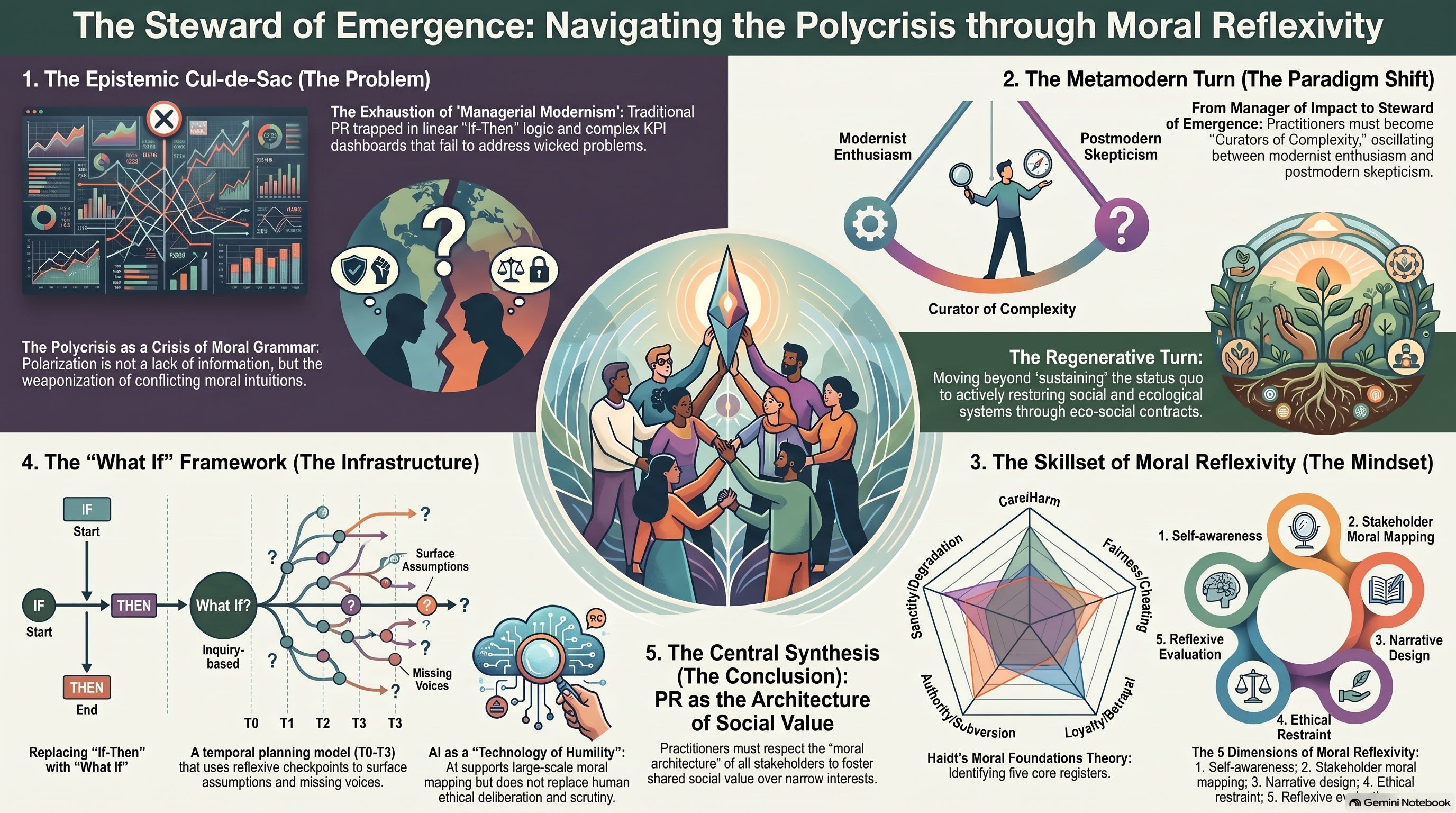
As metamodernists, we don’t aim to reinvent the wheel, but we aim to change perspectives and keep them fluid. If polarisation is a crisis of moral grammar rather than a deficit of information, then the reflexive checkpoint “what if we’re missing voices?” is not a courtesy question. It is a prompt to ask which moral registers are absent from a stakeholder map — and moral reflexivity, the practitioner’s capacity to know their own foundation profile before reading anyone else’s, becomes an interior competency rather than an ethics module.
The empirical ground under this is the Future of PR/Comms Delphi study: four rounds, more than 600 initial participants across 24 countries, 314 of whom completed all four (Adi & Stoeckle, 2023). Close to 22% of valid responses showed distinctly metamodern characteristics without anyone having handed the participants the vocabulary (Adi, Aktaş Kuyucu, & Baquerizo-Neira, 2025). Practitioners were already reasoning in both/and before the theory arrived to name it. Various EUPRERA panels and presentations left us with a similar feeling. There is common ground, and we should name and own it as such.
Informed trust, from a regenerative and metamodern lens
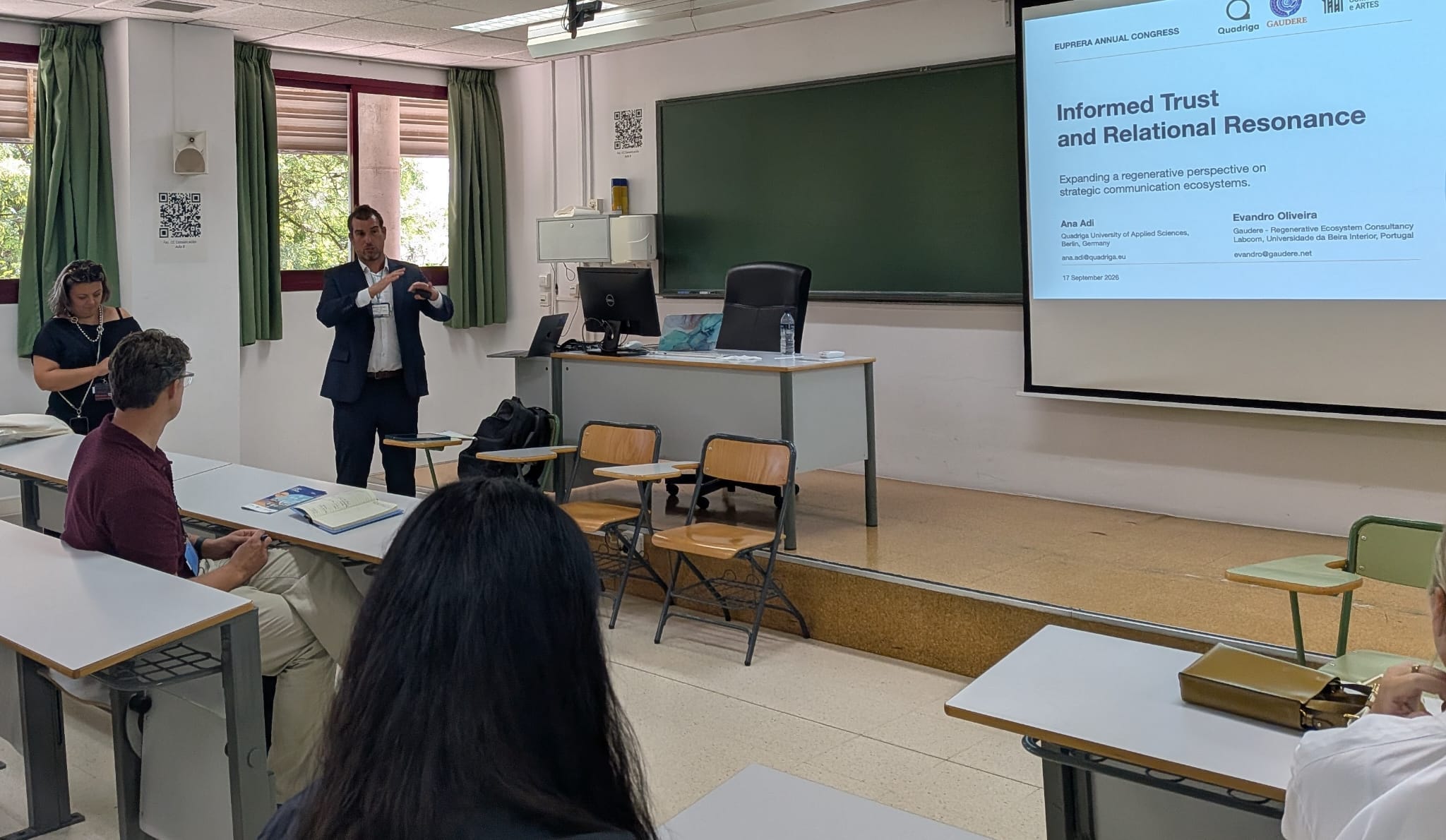
The second paper, with Evandro Oliveira, took trust in a direction neither of us would have taken alone: informed trust as something that emerges from regenerative theory rather than being produced by transparency measures bolted onto an organisation that has not changed. Trust as a property of a relational field rather than an output an organisation manufactures and then reports. And relational vitality as a key indicator for an organisation’s ability to operate with trustworthiness and purpose in challenging times.
Five classrooms, five countries
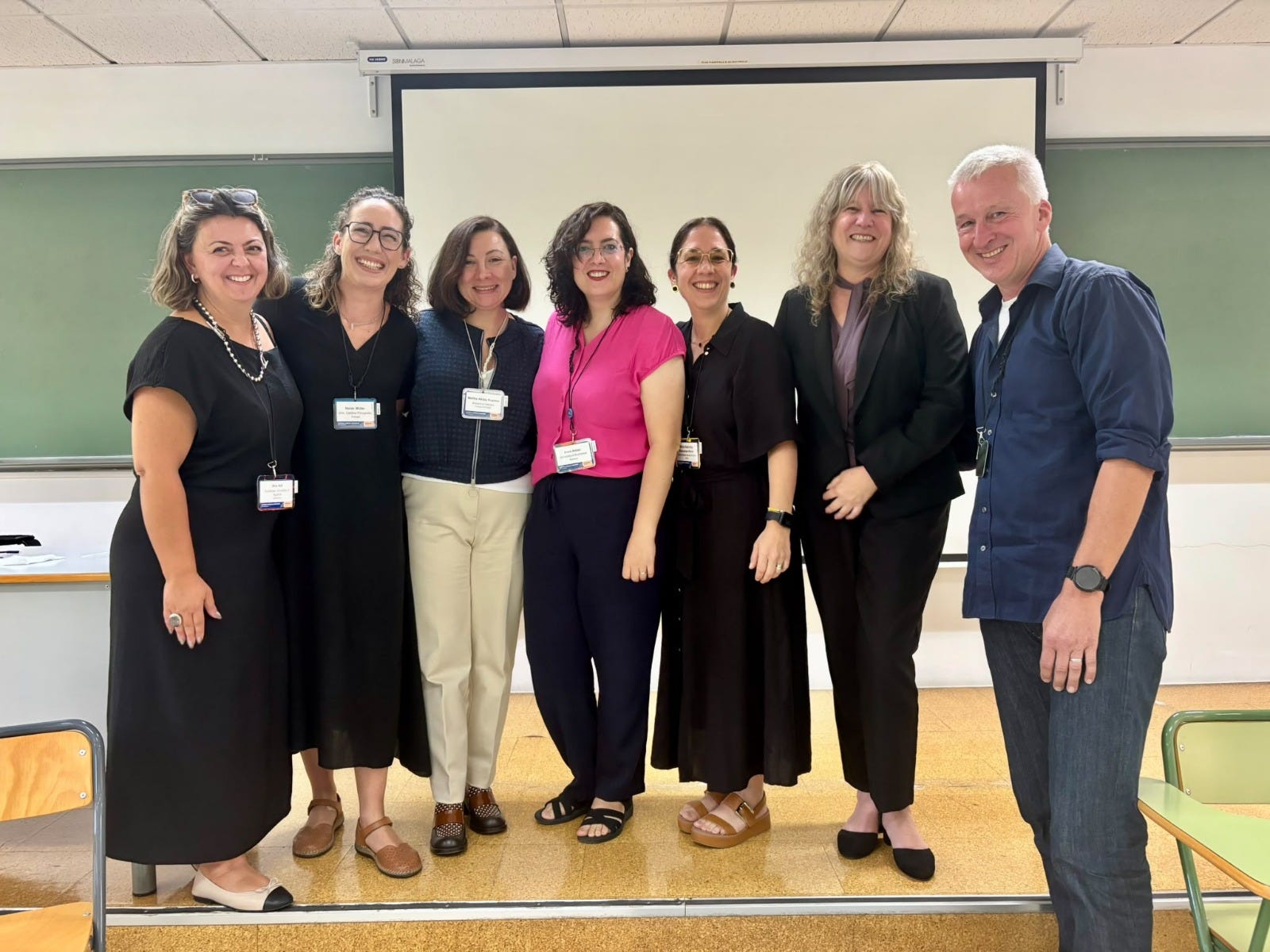
The panel we convened is the part that truly matters. Colleagues from Romania, Türkiye, Portugal, Chile and Argentina presented preliminary results from running the What If framework with their own students: not a pilot we designed and they administered, but five separate readings of what happens when the workflow meets a real cohort, a real syllabus and a language it was not written in. Thank you Naíde Müller, Anca Anton, Gabriela Baquerizo, PhD, Carolina A. Carbone and Melike Aktaş Kuyucu for the trust and support!
We are not going to summarise findings their teams have not finished analysing, and we are not going to average five sites that were never running the same study. What we will say is what we will be looking for when the write-ups come: the adaptations. What each colleague changed to make the workflow survive contact with their own cohort is the valuable part, and it is the first thing lost when five sites are aggregated into one clean table. Hopefully, this is just the start. For the 28th Annual EUPRERA Congress in Leipzig next year, we hope to have grown the community.
What a congress can and cannot measure
Here is where one of us reaches for the measurement ground, because the temptation in a week like this is obvious. Sessions, acceptances, hallway conversations and invitations are inputs. They are also, conveniently, the numbers that are easy to count and flattering to report — which is the exact structure we have spent years criticising in our own profession’s evaluation habits. Counting the times a word is used is an output metric wearing the clothes of an outcome (we caved to that temptation earlier telling you we had 3 contributions to the congress, and that is fair - while papers were connected by theme, ours were connected by paradigm and approach)
The distinction we keep insisting on applies to us here without adjustment: social impact is what changed (as the result of an organisational intervention), social value is what that change is worth to the people it happened to. On the classroom strand, that means the question is not how many students completed a What If exercise (though, we’d still like more to go through it). It is whether anything in the value spectra shifted for them — positive/negative, planned/accidental, desired/undesired — and whether the accidental and undesired parts get reported at all when the people reporting are collaborators who would like the framework to work.
Friction is the primary data here. Enthusiastic adoption is the weaker signal, and it deserves more suspicion, not less.
The metamodern part, which is not decoration
The modern reflex, faced with a term you have to define in every room, is to fix the definition: standardise it, certify it, get it into the textbooks, declare a paradigm shift and start the association. The postmodern reflex is the shrug — every discipline cycles through a fashionable adjective, regenerative is this year’s, it might be systemic (yet again!) by 2028, nothing underneath moves.
We hold the third position, which is harder to be with and less satisfying to announce, and which is what we actually had to demonstrate rather than assert in Málaga. What the metamodern move gave those rooms was not a better label. It was two things the other two positions cannot supply together: oscillation, which lets a researcher hold a framework and its refutation in the same design instead of choosing one and defending it, and humility, which lets a lecturer put an unfinished framework in front of students as something to test and (if need be) break rather than something to apply. Interest in that is real evidence of something and weak evidence of practice. Both, at once, with no plan to resolve which.
And the reflexivity clause, since it applies to us: we convened the panel that reports on our own framework, we co-authored two of the papers that argue for it, and this post was drafted with AI assistance by two people who argue that generative AI in communication planning should function as a technology of humility rather than a content engine. We are not assessing this from a balcony. We are counting our own attendance.
What we are learning, in both directions at once: we are more convinced than before that the metamodern move is useful to academic work specifically — the questions that came back were about designs and syllabi, not definitions, which is what interest looks like when it is more than courtesy — and less confident than before that any of this has yet become shared vocabulary in our discipline, since we defined the term from scratch every time and the congress itself reached for regeneration instead.
The question we cannot close: does a discipline that finds the argument persuasive in a session change what gets taught in January, or does it acquire a better description of what it was already doing? We do not know. Held, not solved. Wicked times demand more than tame solutions, and a congress is not a solution — it is a room where the problem was stated well.
There is interest, and it is more than polite. If you teach strategic communication and want to run the framework with a cohort next semester, or you are a practitioner willing to keep a reflexive diary while you use it on live work, the materials are open and we would like to hear from you — including, and especially, if it does not work in your context. That is the finding we are shortest of. Comment on this substack, come find us at whatifadvisory.net or reach out to us on LinkedIn.
So: what is the idea you still have to define every time you use it — and what has having to define it taught you that a shared word would have hidden?
References
Adi, A., Aktaş Kuyucu, M., & Baquerizo-Neira, G. (2025). Embracing paradox and pragmatism: A metamodern exploration of the social value of public relations. Public Relations Review, 51(5), 102640. https://doi.org/10.1016/j.pubrev.2025.102640.
Adi, A., Aktas Kuyucu, M., Anton, A., Baquerizo Neira, G., Carbone, C, Muller, N., Stoeckle, S. (2026, September 16-19) Teaching in Uncertainty: Testing the Metamodern "What If" Framework Across Educational Contexts, [Panel Discussion]. 27th EUPRERA Annual Congress, University of Málaga, Spain.
Adi, A., & Stoeckle, T. (2023). The future of PR/Comms and their social impact: Results of an international Delphi method study. Quadriga University of Applied Sciences.
Adi, A., & Stoeckle, T. (2025). A metamodern public relations workflow for the polycrisis: Communication research and planning based on a What If framework. Public Relations Review, 51(4), 102619. https://doi.org/10.1016/j.pubrev.2025.102619
Adi, A., & Stoeckle, T. (2026a, September 16–19). Stewards of emergence: Metamodern strategic communication, regenerative orientation, and moral reflexivity in polycrisis conditions [Conference presentation]. 27th EUPRERA Annual Congress, University of Málaga, Spain.
EUPRERA. (2026). 27th EUPRERA Annual Congress: Regenerating public relations and strategic communication in the face of the new global order — are we ready for this challenge? University of Málaga, 16–19 September 2026. https://euprera.org/what-we-do/annual-congress/ ;
Oliveira, E., & Adi, A. (2026, September 16–19) Informed Trust and Relational Resonance: Expanding a Regenerative Perspective on Strategic Communication Ecosystems [Conference presentation]. 27th EUPRERA Annual Congress, University of Málaga, Spain.