
Authenticity statement: researched and first-drafted with AI assistance (Claude, via the What If Dispatch workflow), edited and approved by Ana and Thomas.
When you spend years arguing that PR/Comms needs a metamodern mindset and workflow for the polycrisis (and then build it, and then try to test it), it is easy to suspect you are talking to yourselves. But now it seems that we (and Irma Meyer, the first to apply it to PR) are no longer alone with our metamodern thinking and vocabulary (wicked problems, holding tensions, polycrisis). We had an inkling this summer that it’s becoming more of a theme for communication scholarship as the ICA held its own dedicated metamodernism pre-conference and Heather Yaxley and Sarah Bowman published two books with a metamodern take (one on public affairs and the other on adventurous learning in higher education).
So what does this mean?
In Frontiers in Political Science, Tiffany G. Williams (Jena) reads Germany’s *Zeitenwende* and the wider metacrisis through metamodernism’s metaxis: the in-betweenness of holding two irreconcilable positions without collapsing either. Governance, in her metamodern account, is not the resolution of contradiction but the practice of dwelling inside it. She is not citing us, and we are not citing her as evidence for our position. That is exactly what makes it interesting: the same conceptual move, arrived at independently, in the discipline next door.
Meanwhile, Christian Sarkar and Philip Kotler — yes, that marketing scholarship grandee Kotler — continue to run The Wicked 7 Project, which names seven interlocking problems and argues metamodernly (without using the label):
inequality,
hate and conflict,
power and corruption,
work and technology,
health and livelihood,
population and migration, and
the death of nature.
This is not a list but an ecosystem, in which each element is partly a symptom of the others. The selection process began from four questions (and they remind us of the megatrends research) cross-read against the World Economic Forum’s global risks work:
What are the most urgent issues
How did we get here
What are the root causes
What must be done now
Above which sits the project’s own question: can we solve the world’s most urgent problems?
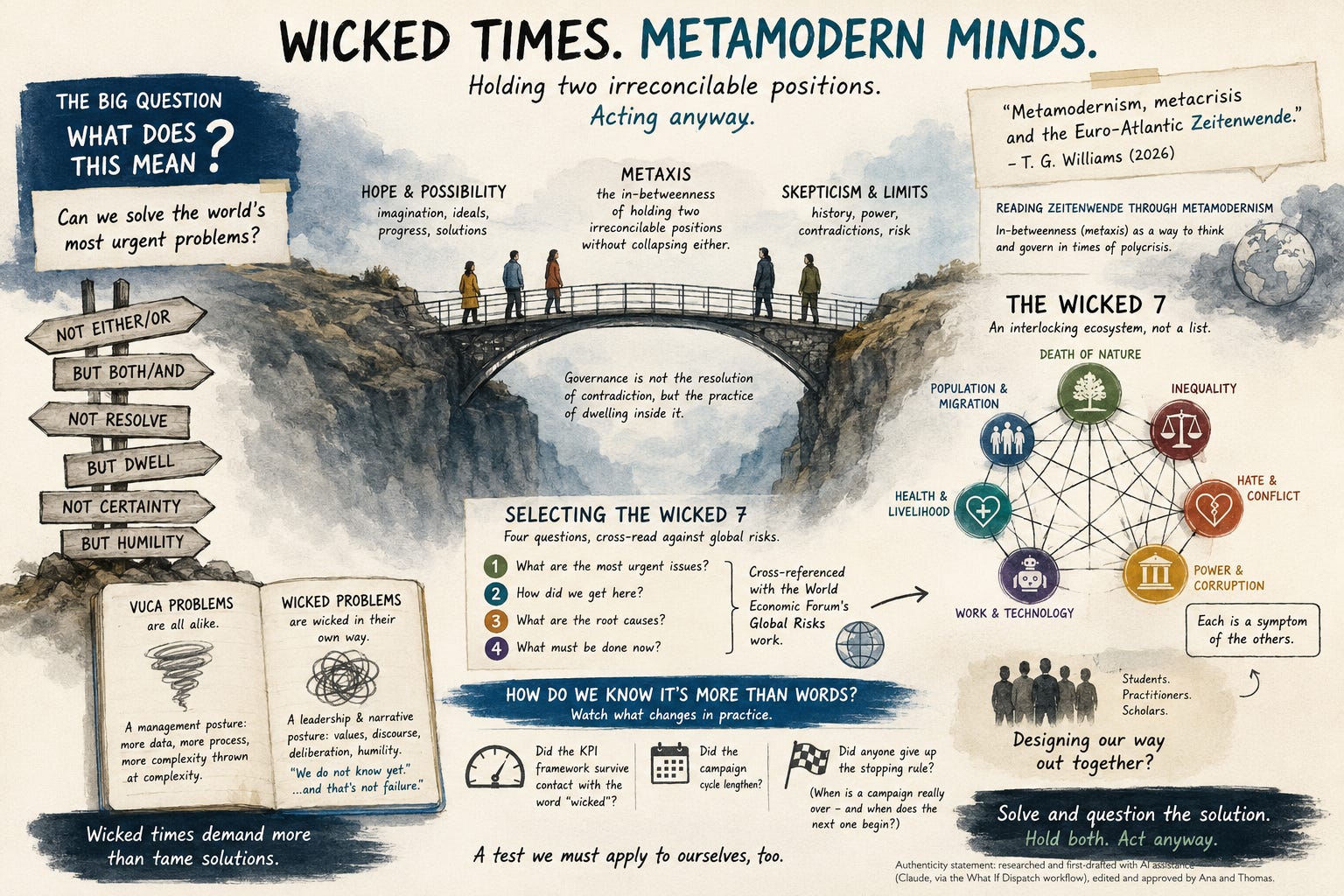
That question is the whole tension, and we would rather name it than smooth it over.
Urban planning scholars Rittel and Webber defined wicked problems in a seminal paper in 1973: no definitive formulation, no stopping rule, solutions that are better or worse rather than true or false, and every attempt leaving irreversible traces. In our own BledCom paper on sustainability communication we put the difference as a Tolstoy analogue:
VUCA problems are all alike; every wicked problem is wicked in its own way. VUCA is a management posture: more data, more process, more complexity thrown at complexity. Wickedness is a leadership and narrative posture: values, discourse, deliberation, and the humility to say *we do not know yet* without treating that as failure.
Willis calls it humble intelligence; Jasanoff calls deliberative citizen participation a technology of humility.
The vocabulary of humility is well stocked. The practice is not (a bit like ethics).
So when a marketing legend like Kotler frames seven wicked problems as a design project to save humanity from itself, we hold two readings at once, and we mean both.
The first is optimistic. Naming the interconnection is the harder half of the work, and a project that convenes students, practitioners and scholars around it does more good than another taxonomy nobody applies.
The second is more skeptical and is the one that keeps us up: the moment “wicked” becomes a badge (a way of signaling that you understand complexity - VUCA being another example) it joins engagement, dialogue and stakeholder in the drawer of laundered words (see Kristin Demetrious’ work on PR shaping language). Vocabulary that once did analytical work, reduced to a tone of voice (and no, we don’t want to be the only ones writing about this stuff, but there IS a genuine question about concepts that get mainstream).
Policing the terms is not the answer. Instead, we should keep asking what changes in practice when someone adopts them.
Did the KPI framework survive contact with the word “wicked”?
Did the campaign cycle lengthen?
Did anyone give up the stopping rule (when is a campaign really over and when does the next one begin?)
That is a test we would like to apply to ourselves, too, and we are not confident we always pass it. *Solve and question the solution* is easier written than practised, and considerably easier to publish than to bill.
Wicked times demand more than tame solutions (we said so before). What we cannot tell you yet is whether the vocabulary spreading is evidence of the practice spreading — or the most efficient way to avoid it.
Have you seen metamodern thinking and application, or a true acknowledgement of wicked problems, in the wild — and has it changed how anyone around you actually works?
References
Adi, A., & Stoeckle, T. (2023). *Can PR solve wicked problems? A theoretical, conceptual study of PR’s challenges with sustainability communication.* BledCom 2023.
Adi, A., & Stoeckle, T. (2025). A metamodern public relations workflow for the polycrisis: Communication research and planning based on a what if framework. Public relations review, 51(4), 102619.
Rittel, H. W. J., & Webber, M. M. (1973). *Dilemmas in a general theory of planning.* Policy Sciences, 4(2), 155–169. https://doi.org/10.1007/BF01405730
Sarkar, C., & Kotler, P. The Wicked 7 Project. https://www.wicked7.org/ · Selecting the Wicked 7: https://www.wicked7.org/selecting-the-wicked-7/ · overview of the seven problems: https://connects.world/confronting-the-wicked-7-challenges-of-our-time/
Williams, T. G. (2026). *Metamodernism, metacrisis and the Euro-Atlantic Zeitenwende.* Frontiers in Political Science, 29 June 2026. https://www.frontiersin.org/journals/political-science/articles/10.3389/fpos.2026.1761619/full