What If First Dispatch
Why we started with a refusal

Authenticity statement: *Drafted with AI research assistance from Claude and based on our own writings, reviewed and edited by Ana Adi & Thomas Stoeckle
—-
This is the first issue of What If Dispatch, so before anything else: what it is, why it exists, and what you can expect if you stay.
We will start with the uncomfortable part, because the whole project starts there.
## The thing PR/Comms won’t say
We work in a field that persuades for a living and rarely admits it - plenty of talk about advising and staying in the shadows so that the protagonists can shine. But here’s the thing, public relations, corporate communications, “engagement,” “dialogue,” “storytelling,” “community” — the words get gentler every year. What they describe does not change. The job is to move people, on behalf of someone who is paying, toward an outcome that someone has chosen.
That is not a confession. Persuasion is a normal human activity and an old and honorable one when it is done in the open. The problem is not that the field persuades. The problem is that it will not say so, and people (call them stakeholder audiences) can tell. People trust least the thing that refuses to name what it wants from them. So the careful language meant to make the work respectable is exactly what makes it look shifty.
We think that is backwards (and others calls this out too (Bakir and colleagues call it organized persuasive communication), and fixing it is the first move: Own the persuasion. Name the intent. Name who is paying. Then accept the scrutiny that comes with saying it out loud. That scrutiny is not the cost of being trusted. It is the proof. (And we didn’t say find a new definition).
## Why now: the ground has moved
None of this would matter as much if the world had stayed calm and/or predictable. It hasn’t.
Crises no longer take turns. Climate, conflict, inequality, the still-unknown effects of artificial intelligence — they arrive at the same time and feed each other. The economic historian Adam Tooze has a word for it: the polycrisis, meaning several crises compounding into a single tangled one. At its center is what economists call radical uncertainty: not risk you can price and plan against, but situations that are genuinely open, where the future will not hold still long enough to be forecast. That is now the normal condition for every act of communication. Not the exception. It’s like the weather.
Here is the trap: PR/Comms learned and developed its trade on firmer ground. It is no wonder that its instincts were built for tame problems, the kind that yield to standard procedures, clear objectives, and a tidy set of numbers to hit, with focus on growth, on reputation, on the positive. (The distinction between “tame” and “wicked” problems comes from Rittel and Webber, back in 1973, and it has never been more useful.) Tame tools work on tame problems. Applied to wicked ones — the open-ended, interconnected messes with no single right answer — they don’t just fail; they produce well-managed failure and a false sense of security. And the false sense is the dangerous part, because it tells everyone the situation is handled when it is not.
Most of the field’s modern habits are tame tools: the measurement built to prove the department deserves its budget, the inside-out impact, the managerial confidence, the dashboard that answers the easy question so the hard one never gets asked. None of that is wrong at small scale. It is wrong when it is pointed at a wicked world and sold as control.
## So we have a Manifesto and what it actually asks
We’ve been writing and speaking about responbile persuasion and metamodernism and polycrisis and wicked problems, mostly in academic circles for a while now (since at least 2021 judging from our publications). We feel this needs to be distilled into something (this?) that summarizes that in plain English and gives direction to our future contributions but also one more avenue to question it all.
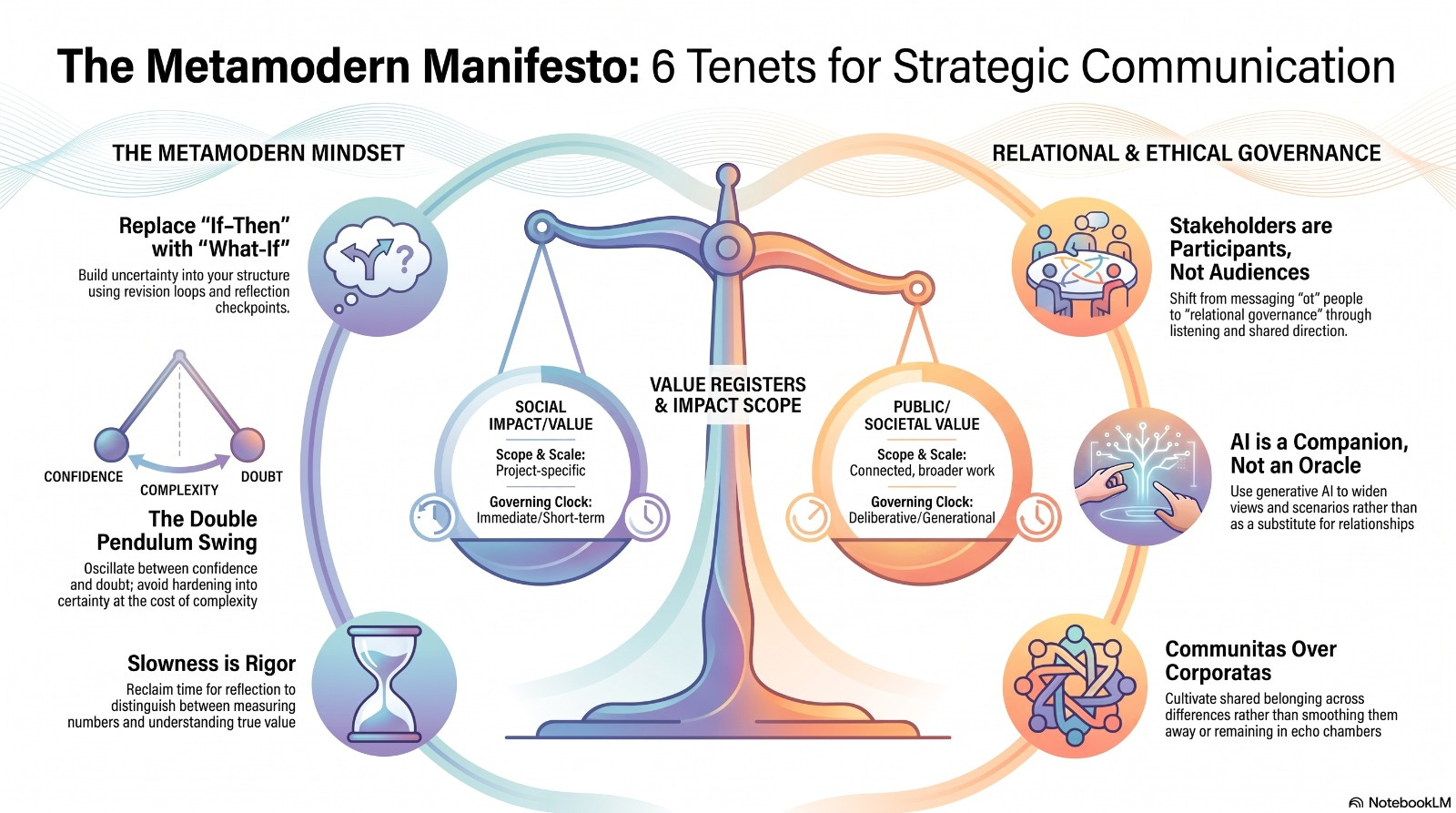
So to start, we wrote a manifesto — What If: A metamodern manifesto for responsible persuasion in the polycrisis. It is live now at whatifadvisory.net, and this Substack is, in part, the place where we plan to keep working out what it means in practice.
A word on “metamodern,” since it does a lot of the load-bearing here and it is easy to wave past.
Modern confidence — we can know, plan, and control — proved too rigid for a wicked world (you heard it before as excellence, as seat at the table).
Postmodern doubt — nothing is stable, everything is constructed — proved too dissolving to act on (you heard about this too as voice, as corporate activism, stakeholder-centric communication).
Metamodernism does not average the two. It also doesn’t negate their achievements, findings and contributions. It oscillates between them, holding sincerity and irony, hope and doubt, at the same time, and leaning whichever way the moment needs. And that’s not convenience and indecision made relative and to suit. It’s about taking things seriously and staying ready to be wrong. Both. And neither, purely.
The manifesto is not a framework to apply. It spells out the tensions to hold — five of them. The idea is that these tensions don’t get solved, but they are to held honestly.
The mandate. - PR/Comms are paid by one party and answerable to everyone their work touches. Both loyalties are real. The job is done inside that tension, deciding case by case and owning each call — not by pretending one loyalty cancels the other.
The uncertainty. - PR/Comms have to decide now and will only know later, if ever, whether they were right. The honest response is not to fake confidence with more data. It is to decide provisionally, write down all assumptions, and treat every plan as a hypothesis with a deadline. When the ground is moving, the virtue is not confidence. It is revisability.
The persuasion. - PR/Comms persuade, and the laundered words for it have stopped fooling anyone. It is time PR/comms made peace with persuasion.
The value. - “Impact” and “value” are not one number. A campaign’s effect this quarter and a change that compounds across a generation sit on different clocks and answer to different people. Those registers need connecting not averaging; never quietly collapse into one metric, because whoever owns that metric quietly owns what counts.
The address. - PR/Comms are not standing outside the message aiming it at other people. The profession and the practitioners are inside the same persuasion environment they help build — persuaded while persuading, trained on the same feeds, exposed to the same synthetic content. Sender and audience at once, and neither purely.
A practice that claims it has resolved these, we think, has just stopped paying attention.
## Responsibility that can’t be handed off
There is one more idea worth naming up front, because it shapes what this Substack will keep returning to. Responsibility in our field usually lives at exactly one level, and that is how it becomes an alibi. The practitioner blames the client. The client blames the market. The profession blames the local rules. And society is told to be more resilient.
The manifesto’s answer is that responsibility lives at four levels at once, none of them delegable to the others:
the personal (am I actually sure about this?),
the professional (codes with no consequences are just decoration),
the organizational (incentives decide outcomes, so a good campaign bolted onto a bad business model is washing, however sincere), and
the societal — the largest, most outward-facing and at times not even in sight.
A field that persuades for a living owes the public the ability to see persuasion for what it is (we made that point here). That means persuasion literacy, and now AI literacy alongside it, belong in general education, not just in our trade schools. A field that teaches people to recognize persuasion is building the very scrutiny that will hold it accountable. We think that is the point, not the risk.
## What you’ll get here
That is the thinking. Here is the practice.
Most weeks you will get a short read that takes something current — a news moment, a development in how communication is taught or researched, a concrete AI case, or something we are actively working on — and looks at it mostly through this metamodern lens. Not “here is what happened,” but “here is the tension inside what happened, and here is what holding it might look like.”
Some weeks the research will be thin, and we will say so and keep it short. A lean, honest issue beats a padded one that hits every note badly. We would rather be two days late than waste your attention.
And every post will tell you plainly how it was made, including where AI helped — you can see that line at the top of this one. A Substack that argues for owning persuasion and for AI honesty has to practice both, or it is just more of the laundering we are complaining about. So we show the seams on purpose.
## The invitation
This is a reorientation. There is nothing to join (unless, if you really like or are intrigued by our ideas, subsbribe to this Substack).
The invitation is smaller and harder than that: take the five tensions into your own week, into the meeting and the coffee break. Look at the four levels of responsibility and notice which one you have quietly been handing to someone else. Then try something different — name one thing you no longer believe, out loud, where it costs you something. And if you feel like sharing, let us know how it felt and went - in the comments, on LinkedIn or DM us.
In the upcoming weeks we’ll explain in more detail the points and positions in the manifesto and after that we aim to bring you metamodern commentaries on PR/Comms practice, examples, research. We’ll bring you our musings, our updates and doubts and lessons learned.
Welcome to What If Dispatch. Rigorous uncertainty, delivered occasionally — and we mean both halves.
— Ana & Thomas
*If this was useful, forward it to one person who’d get something from it.*